


Page 44 - IOE_Winter 24
P. 44
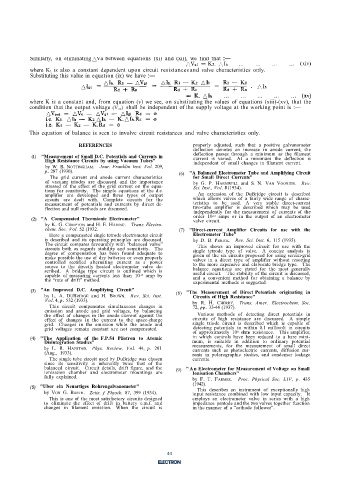
Similarly,  on eliminating  Va  between  equations  (xi)  and (xii),  we  find  that :-
            where  K 2  is  also  a  constant dependent  upon circuit  resistances and valve  characteristics  only.
            Substituting this value in equation (ix) we  have :-


           where K is  a constant and, from equation  (v)  we  see,  on substituting the values  of  equations (xiii)-(xv),  that  the
           condition that the output voltage (V out)  shall be independent of the supply voltage at the working point is :-


           This equation  of  balance is  seen to involve  circuit  resistances  and valve characteristics only.

                             REFERENCES                              properly  adjusted, such  that  a  positive galvanometer
                                                                     deflection  denotes  an  increase  in  anode  current;  the
            (1)  "Measurement of Small D.C. Potentials and Currents  in   deflection passes  through  a  minimum  as  the  filament
                 High Resistance Circuits by using Vacuum Tubes"     current  is varied.  At  a  minimum the  deflection is
                                                                     independent  of  small changes  in  filament  current.
                 by W.  B.  NOTTINGHAM.  Jour. Franklin  Inst.  Vol. 209,
                 p. 287  (1930).                                (6)  "A Balanced Electrometer Tube and Amplifying Circuit
                   The  grid current  and  anode current  characteristics   for  Small Direct  Currents"
                 of  vacuum  triodes  are  discussed  and the  importance   by  G.  P.  HARNWELL  and  S.  N.  VAN  VOORHIS.  Rev.
                 stressed  of  the  effect  of  the  grid current  on the  equa-   Sci. Inst., Vol. 5 (1934).
                 tions  for sensitivity.  The  simple  equations  of  the  d.c.
                 amplifier  are  developed  and  three  types  of  output   An  extension  of  the  DuBridge  circuit  is described
                 circuits  are  dealt with.  Complete  circuits  for the   which  allows valves  of  a  fairly  wide range  of  charac-
                 measurement  of  potentials  and  currents  by  direct de-   teristics  to  be used.  A very  stable  direct-current
                 flection and null methods are discussed.            two-tube  amplifier is  described which  may  be used
                                                                     independently  for  the  measurement  of  currents  of  the
                                                                              amps  or  in  the output  of  an  electrometer
                                                                     order  10
                                                                            -12
            (2)  "A  Compensated  Thermionic Electrometer"           valve  circuit.
                 by K. G. COMPTON  and H. E. HARING.  Trans. Electro-
                 chem. Soc. Vol. 52 (1932.                      (7)  "Direct-current  Amplifier  Circuits  for  use  with  the
                  Here a compensated single tetrode electrometer circuit   Electrometer Tube"
                 is  described  and  its  operating principles  are  discussed.   by  D.  B.  PENICK.  Rev. Sci. Inst. 6, 115  (1935).
                 The circuit  compares favourably with  “balanced valve”   This  shows  an  improved  circuit  for  use  with the
                 circuits  both  as regards  stability  and  sensitivity.  The   single  tetrode  type  of  valve.  A concise  analysis  is
                 degree  of  compensation  has  been  found  adequate  to   given of  the six  circuits proposed for using screen-grid
                 make possible the use of  dry batteries or even properly   valves  in  a  direct type  of  amplifier  without  resorting
                 controlled  rectified  alternating current  as  a  power
                 source  to the  directly  heated  electrometer  valve  de-   to the more  expensive  and elaborate bridge type.  The
                 scribed.  A  bridge  type circuit  is  outlined  which is   balance  equations  are  stated  for  the  most generallv
                                                                     useful circuit. The stability of the circuit is discussed,
                 capable  of  measuring currents  less  than  10 -17   amp  by   and  a  convenient method  for  obtaining  a balance  by
                 the “rate of  drift” method.                        experimental methods  is suggested.
            (3)  "An Improved  D.C.  Amplifying Circuit"       (8)  "The  Measurement  of  Direct Potentials  originating  in
                 by  L.  A.  DUBRIDGE  and  H.  BROWN.  Rev.  Sci.  Inst.   Circuits  of  High Resistance"
                 Vol.  4, p. 532 (1933).                             by  R.  H.  CHERRY.  Trans.  Amer.  Electrochem. Soc.
                  This  circuit compensates  simultaneous  changes  in   72, pp. 33-44 (1937).
                 emission  and anode  and  grid  voltages, by  balancing
                 the  effect  of  changes  in the  anode current  against  the   Various methods  of  detecting direct  potentials  in
                 effect  of  changes  in the  current  to  the  space-charge   circuits  of  high resistance  are  discussed. A  simple
                 grid.  Changes  in  the  emission while  the  anode and   single  triode  circuit  is  described  which is  capable  of
                 grid  voltages  remain  constant  are  not  compensated.   detecting potentials  to  within  0.1  millivolt  in  circuits
                                                                     of  approximately  10 ohms  resistance.  This amplifier,
                                                                                    11
            (4)  "The  Application  of  the F.P.54  Pliotron  to  Atomic   in  which  controls have  been reduced  to  a  bare mini-
                 Disintegration Studies"                             mum,  is  suitable  in  addition  to  ordinary potential
                 by  L.  R.  HAFSTAD.  Phys.  Review,  Vol.  44,  p.  201   measurements,  for  the  measurement  of  small direct
                                                                     currents  such  as  photoelectric  currents,  diffusion cur-
                 (Aug.,  1933).                                      rents  in  polarographic  studies,  and  condenser leakage
                  The single tube circuit  used by DuBridge was chosen   currents.
                 since  its  sensitivity is  inherently  twice  that  of  the
                 balanced  circuit. Circuit  details,  drift  figure,  and the   (9)   "An Electrometer for Measurement of Voltage on Small
                 ionisation chamber  and  electrometer  mountings  are   Ionisation Chambers"
                 fully  explained.                                   by  F.  T.  FARMER.  Proc. Physical  Soc.  LIV,  p.  435
            (5)  "Uber  ein  Neuartiges Rohrengalvanometer"          (1942).
                                                                      This  describes  an  instrument  of exceptionally  high
                 by VON  G. BARTH.  Zeits.  f.  Physik.  87,  399  (1934).   input resistance combined  with low  input  capacity.  It
                  This is one of  the most satisfactory  circuits designed   employs  an  electrometer  valve  in series  with  a  high
                 to  eliminate the  effect  of  drift  in  battery  e.m.f.  and   impedance pentode and the two valves together function
                changes in  filament  emission. When  the  circuit  is   in the manner of  a “cathode follower”.
                                                           11


                                                            44

