


Page 35 - IOE_Winter 24
P. 35
FROM THE ARCHIVES


           The High Stability Electrometer Valve Type BM30
           and its Performance in a Balanced Bridge Circuit

                                              by  W.  BIRTWISTLE*,  M.Inst.E.
           The characteristics of  the Ferranti Single Tetrode Indirectly Heated Electrometer  Valve Type BM30 are outlined-
           with particular reference to the means of securing high stability performance.  The effects of operating the tube at
           various electrode potentials are indicated and details are given of the operation of the valve in a single-battery circuit
           which is stabilised against battery voltage variations by adjusting the resistance network, which supplies the requisite
           electrode  voltages, until  the effect  upon  the output  current  of  small changes  in  battery voltage  is  negligible.


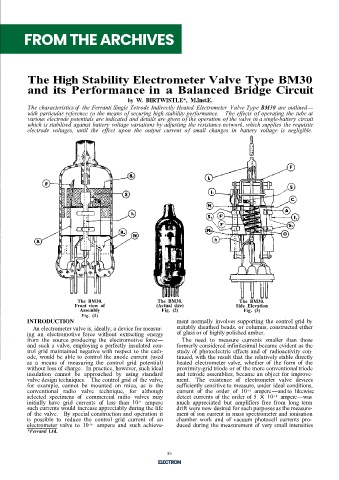
                            The BM30.                   The BM30.                    The BM30.
                           Front view  of               (Actual  size)              Side  Elevation
                             Assembly                     Fig.  (2)                    Fig.  (3)
                              Fig.  (1)
           INTRODUCTION                                        ment  normally involves supporting the control grid  by
             An electrometer valve is, ideally, a device for measur-   suitably sheathed beads, or columns, constructed either
          ing  an  electromotive force  without  extracting  energy   of  glass or of  highly polished amber.
          from  the  source producing  the  electromotive  force-   The  need  to  measure currents  smaller  than  those
           and such a valve, employing a perfectly insulated con-   formerly considered infinitesimal became evident as the
           trol grid  maintained  negative with  respect  to the cath-   study of  photoelectric effects and  of  radioactivity con-
           ode, would  be able to control the anode current  (used   tinued, with the result that the relatively stable directly
          as  a  means  of  measuring the  control  grid  potential)   heated  electrometer valve,  whether of  the form  of  the
           without loss of  charge.  In practice, however, such ideal   proximity-grid triode or of  the more conventional triode
          insulation cannot  be  approached  by  using  standard   and tetrode assemblies, became an object for improve-
           valve design techniques.  The control grid of  the valve,   ment.  The  existence  of  electrometer  valve  devices
           for  example, cannot  be  mounted  on mica,  as  is  the   sufficiently sensitive to measure, under ideal conditions,
           conventional  radio  valve  technique, for  although   current  of  the order  of  10 -16   ampere-and to  likewise
           selected specimens  of  commercial  radio  valves  may   detect currents of  the order of  5  X  10 -18   ampere-was
           initially  have grid  currents  of  less  than  10 -9   ampere   much  appreciated  but  amplifiers  free from  long  term
           such currents would increase appreciably during the life   drift were now desired for such purposes as the measure-
          of  the valve.  By  special construction and operation it   ment of  ion current in mass spectrometer and ionisation
          is  possible  to reduce  the  control  grid  current  of  an   chamber work  and  of  vacuum photocell  currents pro-
          electrometer valve  to  10 -16   ampere  and  such achieve-   duced during the measurement of  very small intensities
           *Ferranti  Ltd.
                                                            2

                                                            35

