


Page 18 - Autumn 2024
P. 18
Industry News
Dr. Yuri Gogotsi, Distinguished University and Bach Author of the paper Dr. Omid Niksan of the
Professor at the Drexel College of Engineering, University of British Columbia adds:
and Co-author of the research, states:
“ Our goal here was to simultaneously improve the
“ For wireless technology to support adjustability of antenna performance as well as
advancements in fields like soft robotics and create a simple manufacturing process for new
aerospace, antennas need to be designed microwave components by incorporating a versatile
for tunable performance and with ease of MXene nanomaterial with kirigami-inspired designs.
fabrication. Kirigami is a natural model for a The next phase of this research will explore new
manufacturing process due to the simplicity with materials and geometries for the antennas.”
which complex 3D forms can be created from a Reference: Gittins, C., ‘Harnessing the ancient Art of Kirigami to create
single 2D piece of material.” Antennas’, IoT Insider, 20th. October.
Industry News
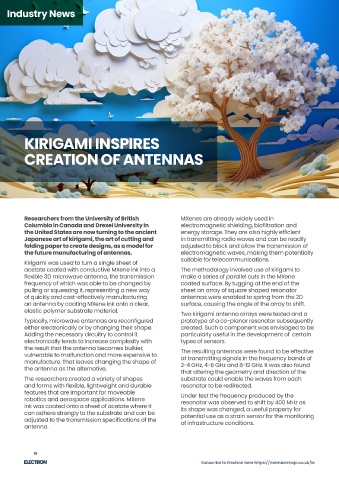
KIRIGAMI INSPIRES
CREATION OF ANTENNAS
NEW MILESTONE FOR
WIRELESS ELECTRIC
Researchers from the University of British MXenes are already widely used in VEHICLE CHARGING
Columbia in Canada and Drexel University in electromagnetic shielding, biofiltration and
the United States are now turning to the ancient energy storage. They are also highly efficient
Japanese art of kirigami, the art of cutting and in transmitting radio waves and can be readily
folding paper to create designs, as a model for adjusted to block and allow the transmission of
the future manufacturing of antennas. electromagnetic waves, making them potentially
suitable for telecommunications.
Kirigami was used to turn a single sheet of
acetate coated with conductive MXene ink into a The methodology involved use of kirigami to
flexible 3D microwave antenna, the transmission make a series of parallel cuts in the MXene
frequency of which was able to be changed by coated surface. By tugging at the end of the Researchers at the Oak Ridge National
pulling or squeezing it, representing a new way sheet an array of square shaped resonator Laboratory, in collaboration with Volkswagen
of quickly and cost-effectively manufacturing antennas were enabled to spring from the 2D Group of America, have successfully
an antenna by coating MXene ink onto a clear, surface, causing the angle of the array to shift. demonstrated a wireless power transfer of
elastic polymer substrate material. 270 kW to a Porsche Taycan, a new record for
Two kirigami antenna arrays were tested and a
wireless electric vehicle charging.
Typically, microwave antennas are reconfigured prototype of a co-planar resonator subsequently
either electronically or by changing their shape. created. Such a component was envisaged to be Current industry standards for wireless charging
Adding the necessary circuitry to control it particularly useful in the development of certain systems for light-duty vehicles cap at 20 kW
electronically tends to increase complexity with types of sensors. with efficiencies at 92 per cent. Now, by utilising
the result that the antenna becomes bulkier, uniquely designed lightweight polyphase
The resulting antennas were found to be effective
vulnerable to malfunction and more expensive to electromagnetic coupling coils, a much higher
at transmitting signals in the frequency bands of
manufacture. That leaves changing the shape of power density has become possible, reducing
2-4 GHz, 4-8 GHz and 8-12 GHz. It was also found
the antenna as the alternative. the size and weight of the charging system that is
that altering the geometry and direction of the
integrated into the undercarriage of the vehicle.
The researchers created a variety of shapes substrate could enable the waves from each
and forms with flexible, lightweight and durable resonator to be redirected. Omer Onar, Leader, Vehicle Power Electronics
features that are important for moveable Group at ORNL, says:
Under test the frequency produced by the
robotics and aerospace applications. MXene
resonator was observed to shift by 400 MHz as “ The receiver coil designed for the Porsche Further research is looking at the use of rotating
ink was coated onto a sheet of acetate where it
its shape was changed, a useful property for Taycan research vehicle can achieve eight to ten electromagnetic fields to enhance efficiency and
can adhere strongly to the substrate and can be
potential use as a strain sensor for the monitoring times higher power density compared to existing reduce voltage issues.
adjusted to the transmission specifications of the
of infrastructure conditions. systems.”
antenna. Reference: ‘US Researchers achieve new Milestone for wireless EV
Charging’, Electrical Review, 2nd. August.
18 19
Subscribe to Electron here https://membermojo.co.uk/ie Subscribe to Electron here https://membermojo.co.uk/ie

