


Page 17 - Autumn 2024
P. 17
Industry News                                                                               Industry News


 OVERCOMING DEFECTS IN   SOUND WAVES HARNESSED


 PEROVSKITE SOLAR CELLS  ON SURFACE OF MICROCHIP


 Perovskite solar cells are known for their    The methodology involved fabrication of   Scientists at the University of Sydney have, for   The material is considered as a soft glass. This
 unique crystal structures and their suitability   solar cell devices in medium (0.25 square   the first time, used lasers to produce, control   means that unlike many materials it operates
 for photovoltaic technologies, which convert   centimetres) and large (1 square centimetre)   and detect high-frequency sound on the   as a guide for the high-frequency sound waves
 light into electricity, but they have been prone   sizes that exhibited low photovoltaic loss   surface of a microchip.  and lets them more freely interact with the light
 to defects.   across a broad range of band gaps while          waves we put into the chip.”
          The design of the chip incorporates a special
 at the same time maintaining high voltage
 Now, researchers at the Hong Kong University   glass made from a combination of germanium,   Lead Author Govert Neijts, a student from the
 output. Surprisingly the devices achieved open-
 of Science and Technology have applied   arsenic and selenide, that is GeAsSe, which   University of Twente in the Netherlands, who
 circuit voltages beyond 90 per cent of the
 passivation techniques, which help reduce   enabled the obtaining of some remarkable   spent nine months at the University of Sydney
 thermodynamic limit, placing them among the
 defects in materials, in order to improve   results including measurements that indicated   laboratories, adds:
 best in the field when benchmarked against
 the efficiency of perovskite solar cells. Such   strong interactions between light and sound.
 some 1,700 data sets obtained from existing                    “ Typically surface acoustic waves are ‘excited’
 technologies have, until now, had a limited
 literature.  With the aid of a technique known as stimulated   using electronics. Here we use photonics, or
 effect on enhancing long-term stability, but
          Brillouin scattering, which is created by an          light energy, to produce the sound wave. This
 the team has made a breakthrough through   The study also highlighted the exceptional
          enhanced feedback loop between photons                approach has multiple advantages, chief of
 the application of amino-silane molecular   operational stability of amino-silane passivated
          (light) and phonons (sound), light is enabled to      which is that light does not produce the heat in
 technology to the passivation of perovskite solar   cells, with these cells maintaining high
          move around the chip creating sound vibrations        the chip that electronic excitation causes.”
 cells.  maximum power point efficiency and power
          as it does so. The feedback process allows light
 conversion efficiency even after 1,500 hours of
 The team identified the types of amines -   waves, produced by lasers, to ‘couple’ with the
 ageing, with the best achieving a champion
 primary, secondary and tertiary -and the   sound waves so as to enhance the power of the
 maximum power point of 19.4 per cent and
 combinations of them that could improve   feedback effect.
 a champion power conversion efficiency of
 the surfaces of perovskite films where defects
 20.1 per cent. This was under the International   Anticipated future applications of stimulated
 typically form. This involved both ‘ex-situ’
 Summit on Organic Solar Cells (ISOS)- L-3   Brillouin scattering include 5G/6G and
 (outside the operational environment) and
 protocol, a standardised testing procedure.  broadband networks, sensors, satellite
 ‘in-situ’ (within the operational environment)
          communication, radar systems, defence
 techniques to observe the interactions between   Assistant Professor Lin Yeng-Hung from the
          systems and radio astronomy.
 the molecules and perovskites.  HKUST Department of Electronic and Computer
 Engineering says:  Senior Author and Project Lead, Dr. Moritz
 The result was a significant increase in the
          Merklein of the University of Sydney Nano
 photoluminescence quantum yield, or PLQY,   “ This treatment is similar to the
          Institute and School of Physics explains:
 indicating fewer defects and improved material   hexamethyldisalazane priming process widely
 quality. This is notably important for the creation   used in the semiconductor industry. Such   “ The use of sound waves on the surface of a
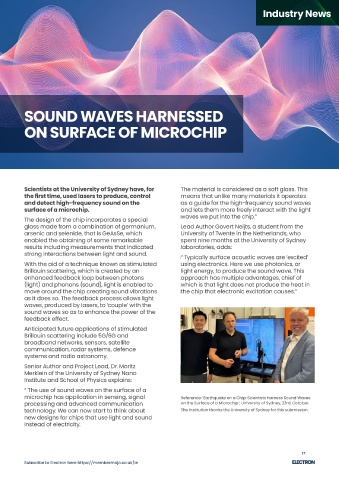
 of so-called tandem solar cells, which combine   similarity suggests that our new method can   microchip has application in sensing, signal   Reference: ‘Earthquake on a Chip: Scientists harness Sound Waves
 multiple layers of photoactive materials in order   easily be integrated into existing manufacturing   processing and advanced communication   on the Surface of a Microchip”, University of Sydney, 23rd. October.
 to absorb different parts of the solar spectrum   processes, making it commercially viable and   technology. We can now start to think about   The Institution thanks the University of Sydney for this submission.
 and thereby maximise efficiency.  ready for large-scale application.”  new designs for chips that use light and sound
          instead of electricity.
    Reference: West, P., ‘Boosting Solar Cell Efficiency and Durability’,
 Electronic Specifier, 1st. October.
 16                                                                                                        17
 Subscribe to Electron here https://membermojo.co.uk/ie  Subscribe to Electron here https://membermojo.co.uk/ie

