


Page 13 - Autumn 2024
P. 13
Industry News                                                                               Industry News


          MODELLING THE COMPLEX PHYSICS


          OF 3D-PRINTED COMPOSITES


 A SMART BUILDING


 CASE STUDY:

 SIMMTRONIC  Researchers from the University of Glasgow
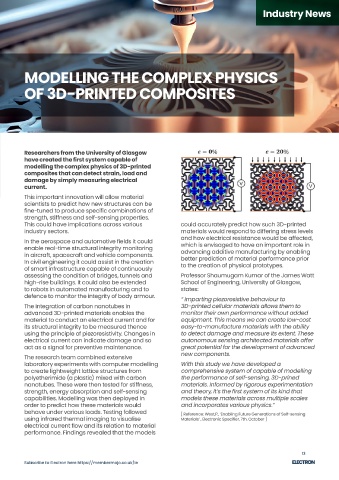
          have created the first system capable of
          modelling the complex physics of 3D-printed
          composites that can detect strain, load and
          damage by simply measuring electrical
          current.
          This important innovation will allow material
          scientists to predict how new structures can be
          fine-tuned to produce specific combinations of
 Simmtronic, a leader in lighting control   Occupancy sensors are used to automatically   strength, stiffness and self-sensing properties.
 systems and smart building infrastructure, has   switch off lights in unused areas and in daylight   This could have implications across various   could accurately predict how such 3D-printed
 recently undertaken a major refurbishment   linking technology adjusts artificial lighting   industry sectors.  materials would respond to differing stress levels
 of its manufacturing site in Hoddesdon. The   based on natural sunlight.  and how electrical resistance would be affected,
          In the aerospace and automotive fields it could
 aim was to create a smart building that would                  which is envisaged to have an important role in
 Integration of smart access control using HID   enable real-time structural integrity monitoring
 improve the working environment and reduce                     advancing additive manufacturing by enabling
 readers allows employees to enter the building   in aircraft, spacecraft and vehicle components.
 energy consumption, whilst at the same time                    better prediction of material performance prior
 with a tap on their mobile phone via Apple   In civil engineering it could assist in the creation
 showcasing the technology that it develops                     to the creation of physical prototypes.
 Wallet, whilst corridor lighting is controlled   of smart infrastructure capable of continuously
 and supplies.
 through entry points.  assessing the condition of bridges, tunnels and   Professor Shaumugam Kumar of the James Watt
 The centrepiece of the retrofit was the creation   high-rise buildings. It could also be extended   School of Engineering, University of Glasgow,
 A major challenge was the integration of
 of a digital twin, that is, a real-time virtual   to robots in automated manufacturing and to   states:
 systems from different manufacturers,
 representation of the physical building powered   defence to monitor the integrity of body armour.
 particularly with the HVAC units being installed               “ Imparting piezoresistive behaviour to
 by a web of sensors and automated systems.
 at different times and operated on various   The integration of carbon nanotubes in   3D-printed cellular materials allows them to
 Simmtronic’s own SPQ7 environmental sensors   protocols, but modern units helped to overcome   advanced 3D-printed materials enables the   monitor their own performance without added
 were installed allowing key factors such as   this.  material to conduct an electrical current and for   equipment. This means we can create low-cost
 carbon dioxide levels, humidity and temperature,   its structural integrity to be measured thence   easy-to-manufacture materials with the ability
 The real-time data generated from the various
 to be measured, as well as volatile organic   using the principle of piezoresistivity. Changes in   to detect damage and measure its extent. These
 sensors and control systems has enabled a 15
 compounds. These sensors feed real-time data   electrical current can indicate damage and so   autonomous sensing architected materials offer
 to 20 per cent reduction in energy consumption,
 into the Building Management System, enabling   act as a signal for preventive maintenance.  great potential for the development of advanced
 which is anticipated to improve further during
 automatic adjustments to be made to optimise                    new components.
 the winter months.  The research team combined extensive
 air quality, lighting and energy consumption
          laboratory experiments with computer modelling         With this study we have developed a
 based on occupancy and environmental   It is concluded that ‘smart building retrofits
          to create lightweight lattice structures from          comprehensive system of capable of modelling
 conditions:  can deliver tangible benefits beyond just
          polyetherimide (a plastic) mixed with carbon           the performance of self-sensing, 3D-prined
 energy savings’ and that ‘retrofitting is not just
 ‘ When carbon dioxide levels rise in an area,   nanotubes. These were then tested for stiffness,   materials. Informed by rigorous experimentation
 a technological upgrade but a sound financial
 the system increases fresh air intake, ensuring   strength, energy absorption and self-sensing   and theory, it’s the first system of its kind that
 decision offering long-term savings and a more
 optimal air quality without excessive energy   capabilities. Modelling was then deployed in   models these materials across multiple scales
 sustainable way to operate buildings’.
 use. This precision-driven approach ensures   order to predict how these materials would   and incorporates various physics.”
 that energy is only used when and where it’s   Reference: ‘How Simmtronic successfully retrofitted its   behave under various loads. Testing followed
 Manufacturing Site’, Electrical Review, Vol.258, No.3, Autumn 2024,   [ Reference: West,P., ‘Enabling Future Generations of Self-sensing
 needed, dramatically reducing waste and wear   p.6-7.  using infrared thermal imaging to visualise   Materials’ , Electronic Specifier, 7th. October ]
 on equipment.’  electrical current flow and its relation to material
          performance. Findings revealed that the models
 12                                                                                                        13
 Subscribe to Electron here https://membermojo.co.uk/ie  Subscribe to Electron here https://membermojo.co.uk/ie

