


Page 9 - Autumn 2024
P. 9
Robotic Berry Harvester matches Human Pickers  Breakthrough helps free up Space for    AI Development for Wind Turbine    Another aspect of the project is the coordination
 Robots to ‘think’  Autonomous Robots                           of Remotely Operated Vehicles (ROVs) and Electric
 A robotic berry harvester, known as Fieldworker
                                                                ROVs deployed from Uncrewed Surface Vessels,
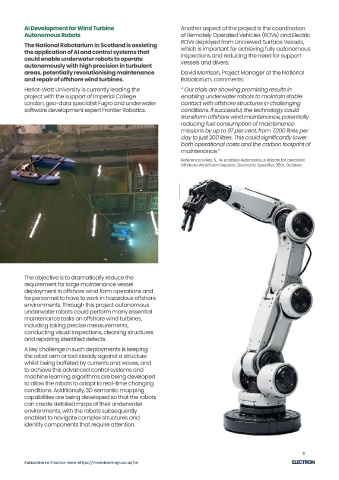
 1, can now harvest berries at the same speed   Researchers at King’s College London   The National Robotarium in Scotland is assisting
                                                                which is important for achieving fully autonomous
 and to the same quality as human pickers,   have devised a way to give robots complex   the application of AI and control systems that
                                                                inspections and reducing the need for support
 providing growers with a predictable cost    instructions without the use of electricity for the   could enable underwater robots to operate
                                                                vessels and divers.
 per berry.  first time, which is envisaged to free up more   autonomously with high precision in turbulent
 space in the robotic ‘brain’ to allow robots to   areas, potentially revolutionising maintenance   David Morrison, Project Manager at the National
 Fieldworker 1 by Fieldwork Robotics is powered by
 ‘think’.  and repair of offshore wind turbines.                Robotarium, comments:
 AI-based technology that allows it to detect berry
 ripeness accurately with the aid of four global   The technique involves transmitting a series   Heriot-Watt University is currently leading the   “ Our trials are showing promising results in
 cameras, eight end effector cameras and    of commands using a new type of compact   project with the support of Imperial College   enabling underwater robots to maintain stable
 spectral frequency.   circuit that utilises variations in pressure of a   London, geo-data specialist Fugro and underwater   contact with offshore structures in challenging
 fluid inside it, creating the potential for a new   software development expert Frontier Robotics.  conditions. If successful, the technology could
 generation of robots with bodies that could operate            transform offshore wind maintenance, potentially
 independently from their built-in control centre, with          reducing fuel consumption of maintenance
 this space being able to be deployed instead for                missions by up to 97 per cent, from 7,000 litres per
 more complex AI-powered software.                               day to just 200 litres. This could significantly lower
                                                                 both operational costs and the carbon footprint of
 The innovation is also envisaged to enable
                                                                 maintenance.”
 the creation of robots that can operate where
 electrically powered devices cannot work, such                 Reference: Miles, S., ‘AI enables Autonomous Robots for precision
                                                                Offshore Wind Farm Repairs’, Electronic Specifier, 25th. October.
 as irradiated areas that destroy circuits, and in
 electrically sensitive environments such as MRI
 rooms.
 The technology involves a reconfigurable circuit
 with an adjustable valve, which is incorporated into
 the robot’s hardware. This valve acts in a manner
 analogous to that of a transistor in a normal circuit
 such that engineers can send signals directly to
 hardware using pressure to mimic binary code. The
 Each payload has four arms with each arm being
 robot can then perform complex activities without
 positioned on a z-axis so each arm can travel up
 and down the z-axis for maximum height and
 reach. Each z-axis has a dedicated global camera
 that scans the bush to detect the location and
 ripeness of the berries. When a suitable berry is
 identified the arm moves up the z-axis to a position
 such that it can extend out on an x-y movement.   The objective is to dramatically reduce the
 At the end of each arm two further cameras are   requirement for large maintenance vessel
 located on the end effector, which is in effect a cup   deployment in offshore wind farm operations and
 that removes the berry from the bush.  for personnel to have to work in hazardous offshore
          environments. Through this project autonomous
 It is intended that fleets of Fieldworker 1 robots
          underwater robots could perform many essential
 will operate with one operator running multiple
          maintenance tasks on offshore wind turbines,
 robots across the field. Both day and night   the need for electricity or instruction  from a central
          including taking precise measurements,
 operation is envisaged and the first trials are set   ‘brain’, so allowing for a greater level of control than
          conducting visual inspections, cleaning structures
 to be conducted on berry farms in Australia in the   that which is possible with current fluid-based
          and repairing identified defects.
 coming months.  circuits.
          A key challenge in such deployments is keeping
 Post-graduate Researcher at King’s College
 Reference: Ford, J., The Engineer, October 2024, p.9.  the robot arm or tool steady against a structure
 London, and author of the study, Mostafa Monsa,
          whilst being buffeted by currents and waves, and
 forecasts:
          to achieve this advanced control systems and
 “ Ultimately, without investment in embodied   machine learning algorithms are being developed
 Visit our website!  intelligence robots will plateau. Soon, if we do not   to allow the robots to adapt to real-time changing
 offload the computational load that modern day   conditions. Additionally, 3D semantic mapping
 Why not head down to our website
 and read more news in our blog?  robots take on, algorithmic improvements will have   capabilities are being developed so that the robots
 little impact on their performance. Our work is just a   can create detailed maps of their underwater
 Updated daily with hand-picked
 articles from around the web...  first step on this path, but the future holds smarter   environments, with the robots subsequently
 robots with smarter bodies.”  enabled to navigate complex structures and
          identify components that require attention.
 institutionofelectronics.ac.uk  Reference: Miles,S., Electronic Specifier, 11th. October


 8                                                                                                         9
 Subscribe to Electron here https://membermojo.co.uk/ie  Subscribe to Electron here https://membermojo.co.uk/ie

