


Page 23 - Autumn 2024
P. 23
Industry News


          such as paraplegia or amyotrophic lateral             3D-printed Medication for Toxoplasmosis
          sclerosis, where muscle paralysis limits the use of
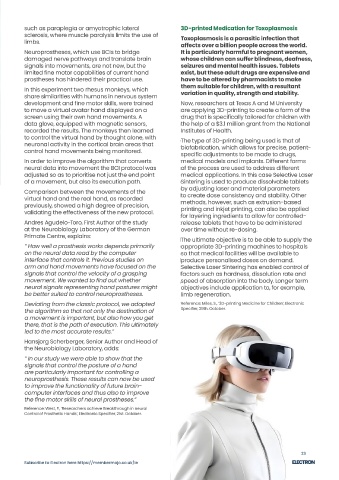
                                                                Toxoplasmosis is a parasitic infection that
          limbs.
                                                                affects over a billion people across the world.
          Neuroprostheses, which use BCIs to bridge             It is particularly harmful to pregnant women,
          damaged nerve pathways and translate brain            whose children can suffer blindness, deafness,
          signals into movements, are not new, but the          seizures and mental health issues. Tablets
          limited fine motor capabilities of current hand       exist, but these adult drugs are expensive and
          prostheses has hindered their practical use.          have to be altered by pharmacists to make
                                                                them suitable for children, with a resultant
          In this experiment two rhesus monkeys, which
                                                                variation in quality, strength and stability.
          share similarities with humans in nervous system
          development and fine motor skills, were trained       Now, researchers at Texas A and M University
          to move a virtual avatar hand displayed on a          are applying 3D-printing to create a form of the
          screen using their own hand movements. A              drug that is specifically tailored for children with
          data glove, equipped with magnetic sensors,           the help of a $3.1 million grant from the National
          recorded the results. The monkeys then learned        Institutes of Health.
          to control the virtual hand by thought alone, with
 MEDICAL FOCUS  neuronal activity in the cortical brain areas that   The type of 3D-printing being used is that of
                                                                biofabrication, which allows for precise, patient-
          control hand movements being monitored.
                                                                specific adjustments to be made to drugs,
          In order to improve the algorithm that converts       medical models and implants. Different forms
          neural data into movement the BCI protocol was        of the process are used to address different
          adjusted so as to prioritise not just the end point   medical applications. In this case Selective Laser
          of a movement, but also its execution path.           Sintering is used to produce dissolvable tablets
                                                                by adjusting laser and material parameters
          Comparison between the movements of the
                                                                to create dose consistency and stability. Other
          virtual hand and the real hand, as recorded
                                                                methods, however, such as extrusion-based
 Using AI to improve Diagnosis    will analyse large sets of referral data with the   previously, showed a high degree of precision,
                                                                printing and inkjet printing, can also be applied
 of Inflammatory Arthritis  machine learning system, RMD-Health, serving   validating the effectiveness of the new protocol.
                                                                for layering ingredients to allow for controlled-
 to identify patterns that may not be initially
 Researchers at the Henley Business School   Andres Agudelo-Toro, First Author of the study   release tablets that have to be administered
 obvious to clinicians.
 have been awarded £600,000 from UK   at the Neurobiology Laboratory of the German   over time without re-dosing.
 Research and Innovation to pioneer a   The project is set to last 18 months and will   Primate Centre, explains:
                                                                The ultimate objective is to be able to supply the
 project that will use machine learning   involve collaboration with the University of Oxford
          “ How well a prosthesis works depends primarily       appropriate 3D-printing machines to hospitals
 to revolutionise the early detection of   and the Royal Berkshire NHS Foundation who will
          on the neural data read by the computer               so that medical facilities will be available to
 inflammatory arthritis, a condition which,   be testing the AI system in real-world clinical
          interface that controls it. Previous studies on       produce personalised doses on demand.
 if diagnosed late, can lead to long-term loss of   settings.
          arm and hand movements have focused on the            Selective Laser Sintering has enabled control of
 mobility. Around 400,000 people in the UK are
 Reference: Miles, S., ‘AI aims to transform early Arthritis Detection and   signals that control the velocity of a grasping   factors such as hardness, dissolution rate and
 estimated to be living with it.  Treatment’, Electronic Specifier, 18th. October.
          movement. We wanted to find out whether               speed of absorption into the body. Longer term
 This ‘power beaming’  is seen as being ‘a The   neural signals representing hand postures might   objectives include application to, for example,
 project will use artificial intelligence to assist   Breakthrough in neural Control   be better suited to control neuroprostheses.  limb regeneration.
 doctors to identify the signs of this crippling   of Prosthetic Hands  Deviating from the classic protocol, we adapted   Reference: Miles, S., ‘3D-printing Medicine for Children’, Electronic
 condition before it becomes far worse. The AI                  Specifier, 29th. October.
 Researchers at the German Primate Centre   the algorithm so that not only the destination of
 - Leibnitz Institute for Primate Research in   a movement is important, but also how you get
 Gottingen have developed a new protocol   there, that is the path of execution. This ultimately
 for brain-computer interfaces (BCI) that has   led to the most accurate results.”
 Visit our   achieved a major advance in prosthetic hand   Hansjorg Scherberger, Senior Author and Head of
 control.  the Neurobiology Laboratory, adds:
 website!  When tested on rhesus monkeys the new
          “ In our study we were able to show that the
 method demonstrated precise manipulation of
 Why not head down to our   signals that control the posture of a hand
 prosthetic hands using neural signals alone.
          are particularly important for controlling a
 website and read more
 Previously BCI research has focused on signals   neuroprosthesis. These results can now be used
 news in our blog section?
 that govern speed of movement, but this latest   to improve the functionality of future brain-
 Updated daily with    research has found that the neural signal   computer interfaces and thus also to improve
 responsible for different hand postures play   the fine motor skills of neural prostheses.”
 hand-picked articles
 a more crucial role in controlling prosthetic   Reference: West, P., ‘Researchers achieve Breakthrough in neural
 from around the web...
 devices. This is anticipated to enhance the fine   Control of Prosthetic Hands’, Electronic Specifier, 21st. October.
 control of neural prostheses, potentially restoring
 institutionofelectronics.ac.uk
 some or all mobility to individuals with conditions

 22                                                                                                        23
 Subscribe to Electron here https://membermojo.co.uk/ie  Subscribe to Electron here https://membermojo.co.uk/ie

