


Page 26 - IOE_Winter 24
P. 26
cultured in a three-dimensional environment they     Robert Katzschmann, Professor of Robotics at ETH
          can potentially originate new hair follicles or hair   Zurich, states:
          shafts, and our study builds on this work.”
                                                                  “ Robots made of soft materials, such as the
          The Dean of the Rensselaer School of Engineering,       hand we developed, have advantages over
          Dr. Shekhar Garde, adds:                                conventional robots made of metal. Because
                                                                  they’re soft, there is less risk of injury when they
            “ Bringing multichannel 3D-printing to the
                                                                  work with humans, and they are better suited to
            biological realm is opening up exciting
                                                                  handling fragile goods.”
            opportunities that would have been hard to
            imagine in the past”.                              [ Reference: West, P., ‘Robotic Hand complete with
                                                               Bones, Ligaments and Tendons’, Electronic Specifier,
          [ Reference: West, P., ‘Scientists 3D-print Hair
                                                               16th. November 2023 ]
          Follicles in Lab-grown Skin’, Electronic Specifier, 16th.
          November 2023 ]
                                                               New Robotic System helps Stroke Survivors track
                                                               Recovery
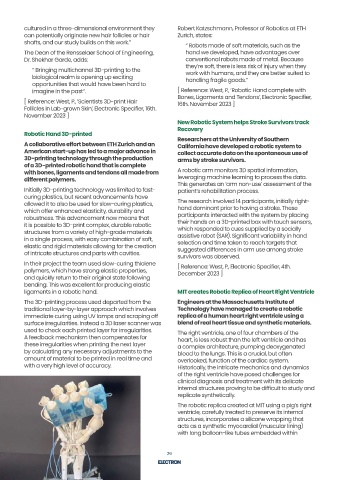
          Robotic Hand 3D-printed
                                                               Researchers at the University of Southern
          A collaborative effort between ETH Zurich and an
                                                               California have developed a robotic system to
          American start-up has led to a major advance in      collect accurate data on the spontaneous use of
          3D-printing technology through the production        arms by stroke survivors.
          of a 3D-printed robotic hand that is complete
                                                               A robotic arm monitors 3D spatial information,
          with bones, ligaments and tendons all made from
                                                               leveraging machine learning to process the data.
          different polymers.
                                                               This generates an ‘arm non-use’ assessment of the
          Initially 3D-printing technology was limited to fast-  patient’s rehabilitation process.
          curing plastics, but recent advancements have
                                                               The research involved 14 participants, initially right-
          allowed it to also be used for slow-curing plastics,
                                                               hand dominant prior to having a stroke. These
          which offer enhanced elasticity, durability and
                                                               participants interacted with the system by placing
          robustness. This advancement now means that
                                                               their hands on a 3D-printed box with touch sensors,
          it is possible to 3D-print complex, durable robotic
                                                               which responded to cues supplied by a socially
          structures from a variety of high-grade materials
                                                               assistive robot (SAR). Significant variability in hand
          in a single process, with easy combination of soft,
                                                               selection and time taken to reach targets that
          elastic and rigid materials allowing for the creation
                                                               suggested differences in arm use among stroke
          of intricate structures and parts with cavities.
                                                               survivors was observed.
          In their project the team used slow-curing thiolene
                                                               [ Reference: West, P., Electronic Specifier, 4th.
          polymers, which have strong elastic properties,
                                                               December 2023 ]
          and quickly return to their original state following
          bending. This was excellent for producing elastic
          ligaments in a robotic hand.                         MIT creates Robotic Replica of Heart Right Ventricle
          The 3D-printing process used departed from the       Engineers at the Massachusetts Institute of
          traditional layer-by-layer approach which involves   Technology have managed to create a robotic
          immediate curing using UV lamps and scraping off     replica of a human heart right ventricle using a
          surface irregularities. Instead a 3D laser scanner was   blend of real heart tissue and synthetic materials.
          used to check each printed layer for irregularities.
                                                               The right ventricle, one of four chambers of the
          A feedback mechanism then compensates for
                                                               heart, is less robust than the left ventricle and has
          these irregularities when printing the next layer
                                                               a complex architecture, pumping deoxygenated
          by calculating any necessary adjustments to the      blood to the lungs. This is a crucial, but often
          amount of material to be printed in real time and
                                                               overlooked, function of the cardiac system.
          with a very high level of accuracy.
                                                               Historically, the intricate mechanics and dynamics
                                                               of the right ventricle have posed challenges for
                                                               clinical diagnosis and treatment with its delicate
                                                               internal structures proving to be difficult to study and
                                                               replicate synthetically.
                                                               The robotic replica created at MIT using a pig’s right
                                                               ventricle, carefully treated to preserve its internal
                                                               structures, incorporates a silicone wrapping that
                                                               acts as a synthetic myocardial (muscular lining)
                                                               with long balloon-like tubes embedded within


                                                            26

