


Page 22 - IOE_Winter 24
P. 22
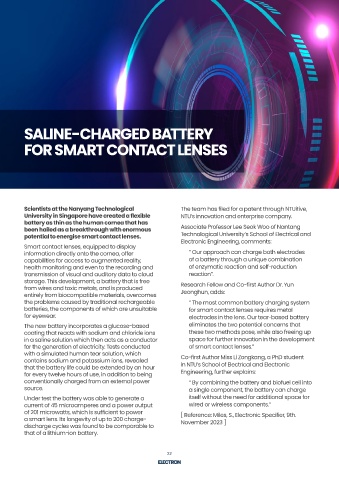
SALINE-CHARGED BATTERY


          FOR SMART CONTACT LENSES


          Scientists at the Nanyang Technological               The team has filed for a patent through NTUitive,
          University in Singapore have created a flexible       NTU’s innovation and enterprise company.
          battery as thin as the human cornea that has
                                                                Associate Professor Lee Seok Woo of Nantang
          been hailed as a breakthrough with enormous
                                                                Technological University’s School of Electrical and
          potential to energise smart contact lenses.
                                                                Electronic Engineering, comments:
          Smart contact lenses, equipped to display
          information directly onto the cornea, offer              “ Our approach can charge both electrodes
          capabilities for access to augmented reality,            of a battery through a unique combination
          health monitoring and even to the recording and          of enzymatic reaction and self-reduction
          transmission of visual and auditory data to cloud        reaction”.
          storage. This development, a battery that is free
                                                                Research Fellow and Co-first Author Dr. Yun
          from wires and toxic metals, and is produced
                                                                Jeonghun, adds:
          entirely from biocompatible materials, overcomes
          the problems caused by traditional rechargeable          “ The most common battery charging system
          batteries, the components of which are unsuitable        for smart contact lenses requires metal
          for eyewear.                                             electrodes in the lens. Our tear-based battery
          The new battery incorporates a glucose-based             eliminates the two potential concerns that
          coating that reacts with sodium and chloride ions        these two methods pose, while also freeing up
          in a saline solution which then acts as a conductor      space for further innovation in the development
          for the generation of electricity. Tests conducted       of smart contact lenses.”
          with a simulated human tear solution, which
                                                                Co-first Author Miss Li Zongkang, a PhD student
          contains sodium and potassium ions, revealed
                                                                in NTU’s School of Electrical and Electronic
          that the battery life could be extended by an hour
                                                                Engineering, further explains:
          for every twelve hours of use, in addition to being
          conventionally charged from an external power            “ By combining the battery and biofuel cell into
          source.                                                  a single component, the battery can charge
          Under test the battery was able to generate a            itself without the need for additional space for
          current of 45 microamperes and a power output            wired or wireless components.”
          of 201 microwatts, which is sufficient to power
                                                                [ Reference: Miles, S., Electronic Specifier, 9th.
          a smart lens. Its longevity of up to 200 charge-
                                                                November 2023 ]
          discharge cycles was found to be comparable to
          that of a lithium-ion battery.


                                                            22

