


Page 23 - Winter 2026
P. 23
Industry News                                                                                Industry News


 NU QUANTUM OPENS

 TRAPPED-ION NETWORKING   UTILISING SPIN LOSS FOR

 LABORATORY IN CAMBRIDGE  MAGNETIC CONTROL


 Nu Quantum has opened a new trapped-ion   The interfaces combine optical microcavity   Scientists at the Korea Institute
 quantum networking laboratory in Cambridge,   technology with custom-built ion traps, allowing the   of Science and Technology
 significantly expanding its research infrastructure.  creation of high-performance entanglement links   Semiconductor Technology
 between remote qubits. This is intended to exceed the   Research Centre, in collaboration
 It will support the development and testing of
 performance of current demonstrations of remote   with Yonsei University, have
 technologies that allow multiple quantum processors
 quantum entanglement.  devised a method to transform
 to be interconnected into a single computing system.
          ‘spin loss’, previously viewed as a
 Nu Quantum’s QPI hardware forms part of its broader
 The achievement of practical large-scale quantum   form of energy waste, into a power
 Entanglement Fabric Technology roadmap, which
 computing is dependent on the ability to scale   source for magnetic control.
 aims to establish a robust photonic networking layer
 beyond individual processors and Nu Quantum’s
 for modular quantum computers. The work builds on   Spintronics, which exploits the spin
 approach involves linking separate quantum
 expertise in optical microcavity mirror fabrication,   property of electrons to process
 processors into a modular, distributed architecture.
 new entanglement protocols and a systems level   and store data, is potentially a key
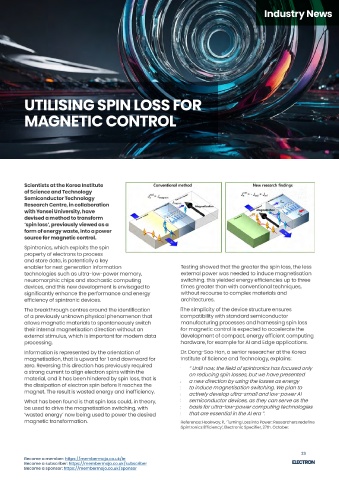
 approach to distributed quantum computing.  enabler for next generation information   Testing showed that the greater the spin loss, the less
          technologies such as ultra-low-power memory,          external power was needed to induce magnetisation
 In 2024 the company announced its first Qubit-
          neuromorphic chips and stochastic computing           switching. this yielded energy efficiencies up to three
 Photon Interface as part of an Innovate UK project
          devices, and this new development is envisaged to     times greater than with conventional techniques,
 with partner Infleqtion.
          significantly enhance the performance and energy      without recourse to complex materials and
 Dr. Carmen Palacios-Berraquero, Founder and Chief   efficiency of spintronic devices.  architectures.
 Executive of Nu Quantum, states:
          The breakthrough centres around the identification    The simplicity of the device structure ensures
 “ The opening of our new laboratory is a huge   of a previously unknown physical phenomenon that   compatibility with standard semiconductor
 milestone as it constitutes the first dedicated   allows magnetic materials to spontaneously switch   manufacturing processes and harnessing spin loss
 industrial R and D facility for trapped-ion distributed   their internal magnetisation direction without an   for magnetic control is expected to accelerate the
 quantum computing in the UK and Europe. This   external stimulus, which is important for modern data   development of compact, energy efficient computing
 state-of-the-art laboratory will accelerate our   processing.  hardware, for example for AI and Edge applications.
 roadmap to enabling interconnected quantum
          Information is represented by the orientation of      Dr. Dong-Soo Han, a senior researcher at the Korea
 computing architectures “.
          magnetisation, that is upward for 1 and downward for   Institute of Science and Technology, explains:
 Dr. Claire Le Gall, Vice-president of Technology for Nu   zero. Reversing this direction has previously required
 Quantum, adds:  a strong current to align electron spins within the   “ Until now, the field of spintronics has focused only
                                                                   on reducing spin losses, but we have presented
          material, and it has been hindered by spin loss, that is
 “ After years of R and D achieving unprecedented                  a new direction by using the losses as energy
 At the centre of the facility is a multi-node networking   the dissipation of electron spin before it reaches the
 cavity performance for fast, efficient quantum                    to induce magnetisation switching. We plan to
 testbed in which Nu Quantum will demonstrate   magnet. The result is wasted energy and inefficiency.
 networking, we are now preparing to test one of                   actively develop ultra-small and low-power AI
 its Qubit-Photon Interface, or QPI, using trapped-
 our core technologies in-house with trapped-ion   What has been found is that spin loss could, in theory,   semiconductor devices, as they can serve as the
 ion qubits. This is designed to connect clusters of
 qubits “.  be used to drive the magnetisation switching, with     basis for ultra-low-power computing technologies
 commercial quantum processors using a scalable                    that are essential in the AI era “.
 Reference: Tyler, N., New Electronics, 10th. February.  ‘wasted energy’ now being used to power the desired
 photonic network, enabling entanglement to be
          magnetic transformation.                              Reference: Hookway, P., ‘Turning Loss into Power: Researchers redefine
 shared between qubits located in different physical
                                                                Spintronics Efficiency’, Electronic Specifier, 27th. October.
 nodes.
 22                                                                                                        23
 Become a member: https://membermojo.co.uk/ie  Become a member: https://membermojo.co.uk/ie
 Become a subscriber: https://membermojo.co.uk/subscriber  Become a subscriber: https://membermojo.co.uk/subscriber
 Become a sponsor: https://membermojo.co.uk/sponsor  Become a sponsor: https://membermojo.co.uk/sponsor

