


Page 19 - Winter 2026
P. 19
Industry News                                                                                Industry News


          MICROSCOPIC LASER


 SILICON CARBIDE DRIVES   TO REDUCE ENERGY

 NEXT GENERATION   CONSUMPTION OF

 MODULAR UPS DESIGN  DATA CENTRES


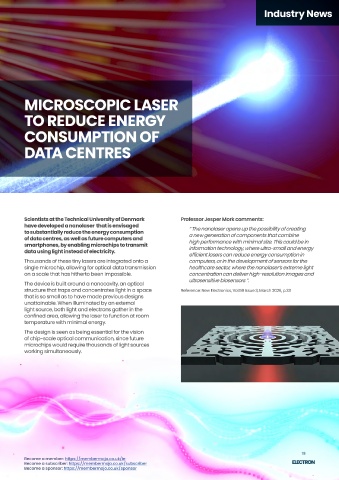
 AI and hyperscale computing are creating rising   Scientists at the Technical University of Denmark   Professor Jesper Mork comments:
 demand and rack densities in data centres. This is   have developed a nanolaser  that is envisaged
                                                                   “ The nanolaser opens up the possibility of creating
 being compounded by high energy costs and the   to substantially reduce the energy consumption
                                                                   a new generation of components that combine
 rapidly fluctuating and unpredictable load profiles   of data centres, as well as future computers and
                                                                   high performance with minimal size. This could be in
 associated with AI applications.  smartphones, by enabling microchips to transmit
                                                                   information technology, where ultra-small and energy
          data using light instead of electricity.
 Traditional uninterruptible power systems (UPSs),                 efficient lasers can reduce energy consumption in
 designed to guarantee resilience and reliability, have   Thousands of these tiny lasers are integrated onto a   computers, or in the development of sensors for the
 been manufactured using Insulated Gate Bipolar   single microchip, allowing for optical data transmission   healthcare sector, where the nanolaser’s extreme light
 Transistors (IGBTs).   on a scale that has hitherto been impossible.  concentration can deliver high-resolution images and
                                                                   ultrasensitive biosensors “.
 Recent research, however, suggests that silicon   The device is built around a nanocavity, an optical
 carbide, or SiC, semiconductors potentially offer:  structure that traps and concentrates light in a space   Reference: New Electronics, Vol.59 Issue 3, March 2026, p.33
          that is so small as to have made previous designs
 • Higher efficiency and reduced losses - SiC
          unattainable. When illuminated by an external
 components exhibit lower electrical resistance
          light source, both light and electrons gather in the
 resulting in reduced energy losses, which helps to   confined area, allowing the laser to function at room
 maximise the overall efficiency of the UPS.  temperature with minimal energy.
 • Increased power density - making it possible   The design is seen as being essential for the vision
 to design more compact and lightweight UPS   of chip-scale optical communication, since future
 systems without compromising overall power   microchips would require thousands of light sources
 capacity.  working simultaneously.
 The SiC components require more energy to
 • Increased thermal stability - SiC can operate at
 manufacture, but this is offset by energy savings
 higher temperatures than IGBTs enabling a higher
 across the UPS lifecycle.
 operational range and lower cooling demands.
 It is foreseen that in the light of the research,
 • Enhanced frequency response - faster switching
 conducted by Riello UPS, who were shortlisted for this
 capabilities produce a more responsive UPS,
 year’s Data Centre World Innovation Product of the
 which is critical for the handling of rapidly
 Year Award, silicon carbide “will likely become the go-
 fluctuating loads, such as those in AI applications.
 to choice to help UPS manufacturers meet the needs
 • Durability - SiC can withstand high surge currents   of modern data centres’ ongoing demand for higher
 and voltage spikes, reducing wear and tear,   efficiency power infrastructure “.
 providing extended component and UPS lifecycles   Reference: Cutler, C., ‘How Silicon Carbide is changing Data Centre
 and reducing maintenance costs.  Power’, Data Centre Review, H1 2026, p.6-7

 18                                                                                                        19
 Become a member: https://membermojo.co.uk/ie  Become a member: https://membermojo.co.uk/ie
 Become a subscriber: https://membermojo.co.uk/subscriber  Become a subscriber: https://membermojo.co.uk/subscriber
 Become a sponsor: https://membermojo.co.uk/sponsor  Become a sponsor: https://membermojo.co.uk/sponsor

