


Page 14 - Spring Summer 2026
P. 14
Industry News Industry News
ELECTRONICS NOW 3D-PRINTING
PRINTED DIRECTLY ELECTRONICS WITH
ONTO COMPONENTS FOCUSED MICROWAVES
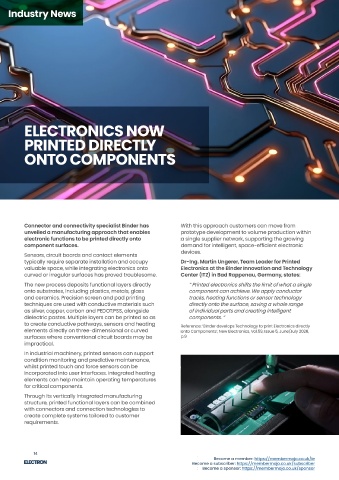
Connector and connectivity specialist Binder has With this approach customers can move from A major challenge in the 3D-printing of electronics tissue, using just a desktop-scale printer.
unveiled a manufacturing approach that enables prototype development to volume production within has been the thermal processing stage in which
The technology deploys a device known as a
electronic functions to be printed directly onto a single supplier network, supporting the growing printed electronic inks have to be heated in order to
metamaterial-inspired, near-field electromagnetic
component surfaces. demand for intelligent, space-efficient electronic become functional. Conventional heating methods
structure, or Meta-NFS, originally developed at the
devices. tend to damage the surrounding materials, especially
Sensors, circuit boards and contact elements University of Singapore. Integrating this into a micro-
in multimaterial structures, which has restricted
typically require separate installation and occupy Dr-Ing. Martin Ungerer, Team Leader for Printed extrusion 3D-printing process enables precise control
printed electronics to a narrow set of materials and
valuable space, while integrating electronics onto Electronics at the Binder Innovation and Technology of heating by tuning microwave parameters such
applications.
curved or irregular surfaces has proved troublesome. Center (ITZ) in Bad Rappenau, Germany, states: that the microstructure and performance of printed
Now, scientists at Rice University have pioneered a new electronics can be adjusted into a single build.
The new process deposits functional layers directly “ Printed electronics shifts the limit of what a single
approach using focused microwave energy to heat just Multifunctional electronic and mechanical properties
onto substrates, including plastics, metals, glass component can achieve. We apply conductor
the printed electronic ink. By confining the microwaves can be programmed into complex, free-form
and ceramics. Precision screen and pad printing tracks, heating functions or sensor technology
to a region the width of a human hair, the team was architectures without having to switch materials or
techniques are used with conductive materials such directly onto the surface, saving a whole range
able to selectively process the ink during printing use manual assembly.
as silver, copper, carbon and PEDOT:PSS, alongside of individual parts and creating intelligent
without degrading temperature-sensitive substrates.
dielectric pastes. Multiple layers can be printed so as components. “ As proof of concept, the researchers printed wireless
to create conductive pathways, sensors and heating The new method allows electronics to be printed onto strain sensors onto ultrahigh-molecular weight
Reference: ‘Binder develops Technology to print Electronics directly
elements directly on three-dimensional or curved onto Components’, New Electronics, Vol.59, Issue 5, June/July 2026, diverse materials, such as biopolymers and living polyethylene, a polymer used in joint replacements,
surfaces where conventional circuit boards may be p.9 and onto a bovine bone and a living leaf, suggesting
impractical. possible applications in areas such as smart
implants and soft robotics.
In industrial machinery, printed sensors can support
condition monitoring and predictive maintenance, Yong Lin Kong, Assistant Professor of Mechanical
whilst printed touch and force sensors can be Engineering at Rice University, states:
incorporated into user interfaces. Integrated heating
“ Selectively heating the printed materials
elements can help maintain operating temperatures
enables us to spatially program the ink’s
for critical components.
functional properties, even when surrounded by
Through its vertically integrated manufacturing temperature-sensitive material. “
structure, printed functional layers can be combined
Reference: ‘Researchers redefine 3D-printing Electronics with
with connectors and connection technologies to focused Microwaves’, New Electronics, Vol.59 Issue 4, April/May 2026,
create complete systems tailored to customer p.33
requirements.
14 15
Become a member: https://membermojo.co.uk/ie Become a member: https://membermojo.co.uk/ie
Become a subscriber: https://membermojo.co.uk/subscriber Become a subscriber: https://membermojo.co.uk/subscriber
Become a sponsor: https://membermojo.co.uk/sponsor Become a sponsor: https://membermojo.co.uk/sponsor

