


Page 13 - Spring Summer 2026
P. 13
Industry News                                                                                Industry News


 FLOW-SENSING ROBOTIC

 WING DEVELOPED AT   SHEFFIELD ENTREPRENEURS INVENT

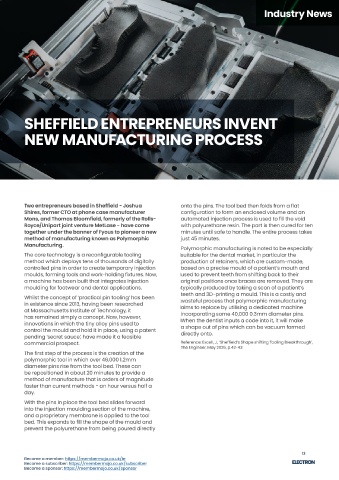
 SOUTHAMPTON  NEW MANUFACTURING PROCESS


 Researchers at the University of Southampton have   In testing the new robotic wing was found to reduce   Two entrepreneurs based in Sheffield - Joshua   onto the pins. The tool bed then folds from a flat
 developed a soft robotic underwater wing that   unwanted uplift impulse (the sudden upward jolt   Shires, former CTO at phone case manufacturer   configuration to form an enclosed volume and an
 can sense changing water conditions and adapt   caused by underwater currents) by 87 per cent   Mons, and Thomas Bloomfield, formerly of the Rolls-  automated injection process is used to fill the void
 to them, potentially improving the stability and   relative to the rigid wings used on today’s AUVs. It also   Royce/Unipart joint venture MetLase - have come   with polyurethane resin. The part is then cured for ten
 efficiency of autonomous underwater vehicles and   responded up to four times faster than comparable   together under the banner of Fyous to pioneer a new   minutes until safe to handle. The entire process takes
 enabling the development of new classes of bio-  soft wing designs and used five times less energy   method of manufacturing known as Polymorphic   just 45 minutes.
 inspired underwater robots.  than systems that rely on thermal actuation.  Manufacturing.
                                                                Polymorphic manufacturing is noted to be especially
 Inspiration was drawn from the concept of   The biggest barrier to scaling the technology was   The core technology is a reconfigurable tooling   suitable for the dental market, in particular the
 proprioception which enables animals to respond   found to be integration with existing vehicle systems.  method which deploys tens of thousands of digitally   production of retainers, which are custom-made,
 rapidly to disturbances, and at the core of the   controlled pins in order to create temporary injection   based on a precise mould of a patient’s mouth and
 Lead Researcher Leo Micklem states:
 innovation is a flexible ‘e-skin’ of liquid metal wires   moulds, forming tools and work-holding fixtures. Now,   used to prevent teeth from shifting back to their
 embedded in silicone that act like artificial nerves.   “ For connection to current systems, rigid   a machine has been built that integrates injection   original positions once braces are removed. They are
 These detect subtle bending caused by water flow   connector pieces would be required for interface   moulding for footwear and dental applications.  typically produced by taking a scan of a patient’s
 and feed signals back to the system. Two internal   between soft and rigid mediums, like we used   teeth and 3D-printing a mould. This is a costly and
          Whilst the concept of ‘practical pin tooling’ has been
 hydraulic tubes then automatically adjust the   in this work. Improvement in this area - to   wasteful process that polymorphic manufacturing
          in existence since 2013, having been researched
 stiffness of the wing and its curvature in real-time so   make the attachment more secure with the   aims to replace by utilising a dedicated machine
          at Massachusetts Institute of Technology, it
 as to allow it to actively counter disturbances.  electrical connections protected - is the primary   incorporating some 40,000 0.3mm diameter pins.
          has remained simply a concept. Now, however,
 requirement.                                                   When the dentist inputs a code into it, it will make
          innovations in which the tiny alloy pins used to
                                                                a shape out of pins which can be vacuum formed
 Most AUVs also use an internal bladder for   control the mould and hold it in place, using a patent
                                                                directly onto.
 buoyancy control that could be used to actuate   pending ‘secret sauce’, have made it a feasible
 the system. However, we are more excited by   commercial prospect.  Reference: Excell, J., ‘Sheffield’s Shape shifting Tooling Breakthrough’,
                                                                The Engineer, May 2026, p.42-43
 the prospect of new underwater vehicles that
          The first step of the process is the creation of the
 could be mostly or fully soft and challenge
          polymorphic tool in which over 46,000 1.2mm
 biological swimmers in terms of efficiency and
          diameter pins rise from the tool bed. These can
 manoeuvrability. “
          be repositioned in about 20 minutes to provide a
 Reference: Ford, J., ‘UK Researchers develop flow-sensing Robotic   method of manufacture that is orders of magnitude
 Wing’ , The Engineer, May 2026, p.8
          faster than current methods - an hour versus half a
          day.
          With the pins in place the tool bed slides forward
          into the injection moulding section of the machine,
          and a proprietary membrane is applied to the tool
          bed. This expands to fill the shape of the mould and
          prevent the polyurethane from being poured directly

 12                                                                                                        13
 Become a member: https://membermojo.co.uk/ie  Become a member: https://membermojo.co.uk/ie
 Become a subscriber: https://membermojo.co.uk/subscriber  Become a subscriber: https://membermojo.co.uk/subscriber
 Become a sponsor: https://membermojo.co.uk/sponsor  Become a sponsor: https://membermojo.co.uk/sponsor

