


Page 20 - Spring 2024
P. 20
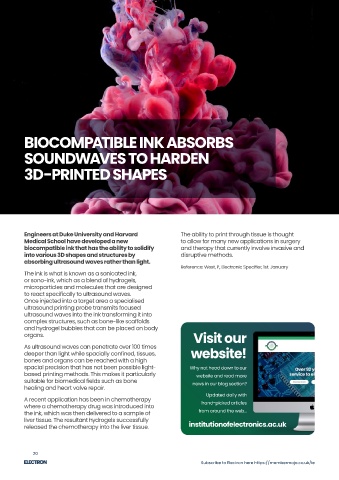
BIOCOMPATIBLE INK ABSORBS


          SOUNDWAVES TO HARDEN

          3D-PRINTED SHAPES


          Engineers at Duke University and Harvard              The ability to print through tissue is thought
          Medical School have developed a new                   to allow for many new applications in surgery
          biocompatible ink that has the ability to solidify    and therapy that currently involve invasive and
          into various 3D shapes and structures by              disruptive methods.
          absorbing ultrasound waves rather than light.
                                                                Reference: West, P., Electronic Specifier, 1st. January
          The ink is what is known as a sonicated ink,
          or sono-ink, which as a blend of hydrogels,
          microparticles and molecules that are designed
          to react specifically to ultrasound waves.
          Once injected into a target area a specialised
          ultrasound printing probe transmits focused
          ultrasound waves into the ink transforming it into
          complex structures, such as bone-like scaffolds
          and hydrogel bubbles that can be placed on body
          organs.
                                                                     Visit our
          As ultrasound waves can penetrate over 100 times
                                                                    website!
          deeper than light while spacially confined, tissues,
          bones and organs can be reached with a high
          spacial precision that has not been possible light-       Why not head down to our
          based printing methods. This makes it particularly
                                                                      website and read more
          suitable for biomedical fields such as bone
                                                                     news in our blog section?
          healing and heart valve repair.
                                                                         Updated daily with
          A recent application has been in chemotherapy
                                                                        hand-picked articles
          where a chemotherapy drug was introduced into
                                                                       from around the web...
          the ink, which was then delivered to a sample of
          liver tissue. The resultant hydrogels successfully
          released the chemotherapy into the liver tissue.         institutionofelectronics.ac.uk


             20
                                                                        Subscribe to Electron here https://membermojo.co.uk/ie

