


Page 24 - Spring 2025 Electron
P. 24
Industry News
Revolutionary Robot uses Ultrasound for early From this virtual reconstruction clinicians can create
Cancer Detection cross-sectional images that mimic those generated
by a standard biopsy.
A tiny robot that can take 3D scans deep within the
body using ultrasound has been developed by a In testing an artificial colon was used with a
team of engineers, scientists and clinicians from robotically controlled external permanent magnet,
the universities of Leeds, Glasgow and Edinburgh. a platform previously developed at Leeds University FURTHER
which enables both joystick and autonomous control
It paves the way for a transformation in the diagnosis
of the oloid magnetic endoscope. Navigation was
and treatment of certain types of cancers by
assisted by images from an embedded camera and DEVELOPMENTS
enabling ‘virtual biopsies’ (non-invasive scans) that
a magnetic localisation system. The oloid magnetic
provide immediate diagnostic data. This should then
endoscope was 3D-printed from resin and has a IN ROBOTICS
enable doctors to detect, stage and potentially treat
diameter of 21 millimetres. The robot could therefore
lesions in a single procedure rather than requiring
still roll, but was of a size and design that was suitable
physical biopsies.
for clinical applications.
Results showed that the system could successfully
perform controlled rolling and sweeping motions
inside the colon, generate high-resolution 3D
ultrasound scans for accurate diagnosis, and identify
lesions in gastrointestinal tissue, so demonstrating its
New Robotic Material mimics Biological
potential for advanced medical imaging and early
Processes
disease detection.
Human trials are due to commence in June 2026. Researchers at Santa Barbara and TU Dresden have
developed a proof-of-concept robotic material
Pietro Valdastri, Professor and Chair in Robotics and that mimics biological processes, allowing it to shift
Autonomous Systems, and Director of the Science between rigid and fluid states.
and Technologies of Robotics in Medicine (STORM)
Lab in Leeds, who also coordinated the research, Inspired by embryonic developments, the technology
states: represents a step towards the creation of adaptable, along each unit’s exterior, which allow robots to
self-assembling robotic structures with robots able to
“ For the first time, this research enables us to behave more like a material. push off each other so as to navigate tightly packed
reconstruct a 3D ultrasound image taken from a spaces. The equivalent of biochemical signalling
probe deep inside the gut, something that has The robotic system is composed of individual, disk- was achieved through a global coordination system
never been done before. This approach enables shaped autonomous robots which can assemble that uses light sensors and polarised filters, while
in-situ analysis and diagnosis of colorectal cancer, into various formations that display different adhesion was achieved by incorporating magnets
with immediate results. The process of diagnosing material properties. This system as a result could into each robot’s perimeter that could be switched on
colorectal cancer currently requires a tissue be both strong and stiff, yet capable of flowing into or off such that the collective could bind together or
sample to be removed, then sent to a lab, with new configurations. Thus, whilst traditional robotic separate as required.
results taking from one to three weeks. “ systems respond to external forces, this system reacts Signal fluctuations proved to be especially useful
to internal signals in order to reshape itself. It can take
Postgraduate researcher Nikita Greenidge from the a shape and hold it, or it can selectively flow itself into in shaping the robotic material’s behaviour. By
School of Electronic and Electrical Engineering at the adjusting inter-unit forces and signal fluctuations the
a new shape.
University of Leeds, and a member of the STORM lab, team could control whether the collective remained
adds: The development builds on the work of Otger rigid or fluid. Increasing both, especially fluctuations,
Campas, a former UC Santa Barbara professor who produced a more flowing material. Then, once in
“ By combining our advanced robotics with now leads the Physics of Life Excellence Cluster at TU formation, switching off the force fluctuations made
medical ultrasound imaging, we take this Dresden. His research on embryonic tissue revealed the collective rigid.
innovation one step ahead of traditional that developing organisms exhibit unique material
colonoscopy, allowing doctors to diagnose and behaviours. In particular they are able to self-shape, Reference: West, P., ‘Researchers develop self-forming Robotic
Material’, Electronic Specifier, 26th. February
treat in a single procedure, eliminating the wait self-heal, control their material strength in space
between diagnosis and intervention. and time, and transform between fluid and solid
Colorectal cancer is one of the leading causes states. This latter property enables cells to reorganise Soft-bodied Robot for Disaster Recovery
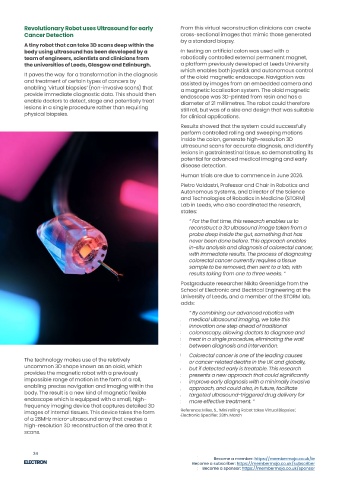
The technology makes use of the relatively themselves and form distinct structures such as
or cancer-related deaths in the UK and globally,
uncommon 3D shape known as an oloid, which but if detected early is treatable. This research limbs and organs. Researchers at Penn State University have
provides the magnetic robot with a previously developed a miniature soft-bodied robot designed
presents a new approach that could significantly The key biological forces involved are namely
impossible range of motion in the form of a roll, improve early diagnosis with a minimally invasive to crawl through rubble in disaster zones, as well
enabling precise navigation and imaging within the active forces (cells applying forces to each other), as being able to travel inside the human body to
approach, and could also, in future, facilitate biochemical signalling (coordinating movement in
body. The result is a new kind of magnetic flexible targeted ultrasound-triggered drug delivery for deliver drugs and collect medical data.
endoscope which is equipped with a small, high- space and time), and cell adhesion (binding together
more effective treatment. “ to maintain structural integrity). Incorporation of With its soft, flexible construction the robot mimics
frequency imaging device that captures detailed 3D the adaptability of living organisms, enabling it
Reference: Miles, S., ‘Mini rolling Robot takes Virtual Biopsies’, these into robotics allowed for the creation of a
images of internal tissues. This device takes the form
Electronic Specifier, 28th. March system that could change shape dynamically. to squeeze into tight, irregular spaces where rigid
of a 28MHz micro-ultrasound array that creates a robots or human tools could not. Flexible electronics
high-resolution 3D reconstruction of the area that it In the robotic material, the equivalent of intracellular were embedded within the flexible body such that
scans. forces was achieved using eight motorised gears
24 25
Become a member: https://membermojo.co.uk/ie Become a member: https://membermojo.co.uk/ie
Become a subscriber: https://membermojo.co.uk/subscriber Become a subscriber: https://membermojo.co.uk/subscriber
Become a sponsor: https://membermojo.co.uk/sponsor Become a sponsor: https://membermojo.co.uk/sponsor

