


Page 23 - Spring 2025 Electron
P. 23
Industry News


                                                                3D-printed Medical Imaging Phantoms
                                                                replicate Human Anatomy

                                                                A joint research effort by Siemens and Stratasys
                                                                has demonstrated a highly accurate 3D-printed
                                                                medical imaging system that uses phantoms to
                                                                replicate human anatomy.
                                                                The system uses Stratasys’ RadioMatrix materials and
                                                                Digital Anatomy technology combined with Siemens
                                                                Healthineers’ advanced algorithms to significantly
                                                                improve the quality of complex anatomical medical
                                                                imaging phantoms, allowing surgeons, researchers
                                                                and educators to replace simplistic anatomical
                                                                phantom models for pre-surgery planning and
                                                                education.
 MEDICAL FOCUS                                                  In particular these anatomically accurate, patient
                                                                specific 3D-printed phantoms are scalable and
                                                                efficient in developing new CT scan algorithms,
                                                                enabling hospitals and imaging centres to enhance
                                                                the calibration and performance of CT scanners.
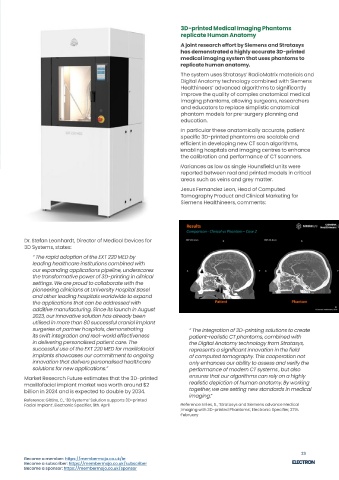
                                                                Variances as low as single Hounsfield units were
                                                                reported between real and printed models in critical
                                                                areas such as veins and grey matter.
 Improving Congestive Heart Failure Detection  suffering from heart disease, focusing especially   Jesus Fernandez Leon, Head of Computed
 on distinguishing between patients with congestive             Tomography Product and Clinical Marketing for
 Physicists at Tampere University have developed a
 heart failure and those that were either healthy or            Siemens Healthineers, comments:
 method of detecting congestive heart failure with
 suffered from atrial fibrillation. By using their new
 greater ease and precision.
 method the team was able to detect congestive
 heart failure with an accuracy of 90 per cent.

 Current methods for detecting congestive heart
 failure typically require costly and time-consuming
          Dr. Stefan Leonhardt, Director of Medical Devices for
 imaging techniques such as echocardiography,
          3D Systems, states:
 and where patients have a regular sinus rhythm
 detection using just inter-beat intervals has often   “ The rapid adoption of the EXT 220 MED by
 been almost impossible. By contrast, atrial fibrillation   leading healthcare institutions combined with
 is comparatively simple to detect.  our expanding applications pipeline, underscores
            the transformative power of 3D-printing in clinical
 With the new method consumer-grade heart rate
            settings. We are proud to collaborate with the
 devices and smartwatches may be used rather than
            pioneering clinicians at University Hospital Basel
 complex diagnostic procedures.
            and other leading hospitals worldwide to expand
 Reference: West,P., ‘Smartwatches may soon detect Congestive   the applications that can be addressed with
 Heart Failure’, Electronic Specifier, 7th. February
            additive manufacturing. Since its launch in August
            2023, our innovative solution has already been
            utilised in more than 80 successful cranial implant
 World First 3D-printed Facial Implant
            surgeries at partner hospitals, demonstrating          “ The integration of 3D-printing solutions to create
 The University Hospital Basel, in collaboration with   its swift integration and real-world effectiveness   patient-realistic CT phantoms, combined with
 3D Systems, has announced the successful design   in delivering personalised patient care. The   the Digital Anatomy technology from Stratasys,
 Congestive heart failure can be reliably detected   and manufacture of the world’s first Medical Device   successful use of the EXT 220 MED for maxillofacial
 by analysing the intervals between successive   Regulation (MDR) compliant 3D-printed PEEK facial   implants showcases our commitment to ongoing   represents a significant innovation in the field
                                                                   of computed tomography. This cooperation not
 heartbeats, known as inter-beats or RR intervals. The   implant.  innovation that delivers personalised healthcare
 new method uses advanced time-series analysis   solutions for new applications.”  only enhances our ability to assess and verify the
                                                                   performance of modern CT systems , but also
 developed by the Quantum Control and Dynamics   The implant was used as part of successful surgery
 conducted at the hospital on 18th. March.  Market Research Future estimates that the 3D-printed   ensures that our algorithms can rely on a highly
 Research Group, which allows for the investigation                realistic depiction of human anatomy. By working
 of dependencies between inter-beat intervals with   Production of the implant was achieved using   maxillofacial implant market was worth around $2
 different time scales, along with other complex   VESTAKEEP i4 3DF PEEK by Evonik on 3D Systems’ EXT   billion in 2024 and is expected to double by 2034.  together, we are setting new standards in medical
                                                                   imaging.”
 characteristics that are typical of various forms of   220 MED. The cleanroom-based architecture of the   Reference: Gittins, C., ‘3D Systems’ Solution supports 3D-printed
 heart disease.  3D-printer and simplified post-processing workflows   Facial Implant’, Electronic Specifier, 9th. April  Reference: Miles, S., ‘Stratasys and Siemens advance Medical
                                                                Imaging with 3D-printed Phantoms’, Electronic Specifier, 27th.
 allowed for the efficient production of patient-specific
 The team analysed multiple international databases             February
 containing long-term electrocardiographs   medical devices directly at the hospital.
 (ECGs) from healthy control subjects and patients


 22                                                                                                        23
 Become a member: https://membermojo.co.uk/ie  Become a member: https://membermojo.co.uk/ie
 Become a subscriber: https://membermojo.co.uk/subscriber  Become a subscriber: https://membermojo.co.uk/subscriber
 Become a sponsor: https://membermojo.co.uk/sponsor  Become a sponsor: https://membermojo.co.uk/sponsor

