


Page 26 - Autumn 2024
P. 26
Industry News


          NEW AI TECHNIQUE


          ACCELERATES HEAT


          PROTECTION CALCULATIONS

          FOR FUSION VESSELS


          A collaboration between Commonwealth Fusion
          Systems, the US Department of Energy’s Princeton
          Plasma Physics Laboratory and Oak Ridge National
          Laboratory has created a new AI technique
          that speeds up calculations that are critical to
          protecting fusion vessels from the extreme heat
          generated by plasma.
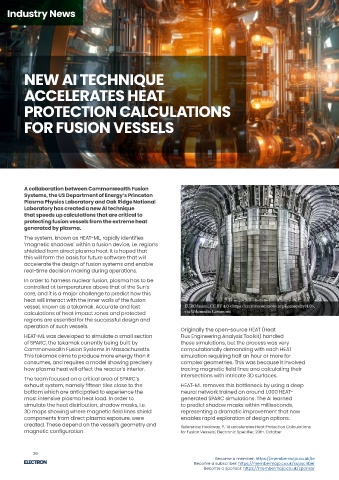
          The system, known as HEAT-ML, rapidly identifies
          ‘magnetic shadows’ within a fusion device, i.e. regions
          shielded from direct plasma heat. It is hoped that
          this will form the basis for future software that will
          accelerate the design of fusion systems and enable
          real-time decision making during operations.
          In order to harness nuclear fusion, plasma has to be
          controlled at temperatures above that of the Sun’s
          core, and it is a major challenge to predict how this
          heat will interact with the inner walls of the fusion
          vessel, known as a tokamak. Accurate and fast
          calculations of heat impact zones and protected
          regions are essential for the successful design and
          operation of such vessels.
                                                                Originally the open-source HEAT (Heat
          HEAT-ML was developed to simulate a small section     Flux Engineering Analysis Toolkit) handled
          of SPARC, the tokamak currently being built by        these simulations, but the process was very
          Commonwealth Fusion Systems in Massachusetts.         computationally demanding with each HEAT
          This tokamak aims to produce more energy than it      simulation requiring half an hour or more for
          consumes, and requires a model showing precisely      complex geometries. This was because it involved
          how plasma heat will affect the reactor’s interior.   tracing magnetic field lines and calculating their
                                                                intersections with intricate 3D surfaces.
          The team focused on a critical area of SPARC’s
          exhaust system, namely fifteen tiles close to the     HEAT-ML removes this bottleneck by using a deep
          bottom which are anticipated to experience the        neural network trained on around 1,000 HEAT-
          most intensive plasma heat load. In order to          generated SPARC simulations. The AI learned
          simulate the heat distribution, shadow masks, i.e.    to predict shadow masks within milliseconds,
          3D maps showing where magnetic field lines shield     representing a dramatic improvement that now
          components from direct plasma exposure, were          enables rapid exploration of design options.
          created. These depend on the vessel’s geometry and
                                                                Reference: Hookway, P., ‘AI accelerates Heat Protection Calculations
          magnetic configuration.                               for Fusion Vessels’, Electronic Specifier, 20th. October


             26
                                                                             Become a member: https://membermojo.co.uk/ie
                                                                     Become a subscriber: https://membermojo.co.uk/subscriber
                                                                         Become a sponsor: https://membermojo.co.uk/sponsor

