


Page 43 - Spring Summer 2026
P. 43
Institution of Electronics News                                    Institution of Electronics News


 Method  (b)  is  suitable  for  vessels  of  small diameter   ditions there will always be a signal fed to the ratemeter
 (up to  about  15 inches)  and  gives  a reasonably  linear   which will keep the relay energised  but in  the event of
 response over the middle portion of its range;  the maxi-   complete failure of the Geiger Muller tube (or any com-
 mum  range  being about  10  inches.  This  type  of   ponent  or connection  to the ratemeter) leading to com-
 installation has  been  highly successful  on  certain  types   plete  signal failure,  the relay will  become de-energised
 of pulp  manufacturing plant  in  the  Paper  Industry;  the   and  thus  actuate  an  alarm  or  safety  circuit.  Such a
 output  being fed  into  a  proportional  control  system..   system is built into many industrial level control equip-
 Method (c)  suffers  from the  disadvantage  that  the   ments.
 response curve  is exponential and  the  maximum range   RADIATION SAFETY
 is about 30 inches for most liquids.  The response can   In designing  installations for  level  control by means
 be made  more linear  and  the  range  extended  by  the   of gamma-ray sources,  care  must  be  taken  to ensure
 modification shown in Method (d), a form of which has   that there  will be  no  radiation  hazard to  personnel
 been used as a method of level indication for some bead   responsible  for operating  the  plant  or  maintaining  the
 catalyst towers.   equipment.  There  are  two  types  of  hazard  associated
 One important  limitation  of these  continuous  indica-   with radio-activity.  Firstly  there  is  a  danger arising
 ting systems is that the calibration is affected by source   from  ingestion or contamination  should  radio-active
 decay.  In  the first instance  the whole system must  be   materials  escape from  the  source  container.  This  risk
 calibrated  by making  absolute  determinations  of  the   is virtually  negligible  if  standard radio-graphic source
 contents level  over  the  whole  range,  and thereafter   capsules are  used.  These are  supplied  by the  Atomic
 adjustments  must  be made  to  the  ratemeter  sensitivity   Energy Research  Establishment, Harwell  (Cobalt  60)
 at intervals  to  compensate for  the  decay of the source.   or  the Radiochemical  Centre,  Amersham  (Caesium
 A Cobalt  60 source  decays by  1%  in about  24 days,   137).
 while a  Caesium  137  source decays by  1%  in about  6   Secondly,  there  is  the  hazard  due  to direct  exposure
 months.  Since  pulse  ratemeters  can  be expected  to   of  the body  to  external  gamma-radiation.  This has
 operate  with  an  accuracy  of  ±  1%,  the  overall   been dealt with in the Preliminary Draft of Regulations
 accuracy  on  a  continuous  level  indicator may  be  about   under the Factory (Ionising Radiations) Act, which lays
 ±  2%  of the range.   down maximum  permissible levels for gamma-ray dose
 If  it  is  essential  to  cover a  large  vertical  range of   to  be  received  in  any  working period  by  persons who
 level  indication  by  the gamma-ray method,  the best   may be  exposed  to  radiation  in  the  course  of their
 practical method is to employ an On/Off control system   work.
 and arrange for both source and detector to be traversed   For certain  categories  of worker,  the  maximum  per-
 vertically together.  The  traversing  gear  can  be  driven   missible level  corresponds  to  a dose-rate  of 2.5 mR/hr.
 by a reversing motor controlled by the detector relay so   and for other workers the maximum permissible level is
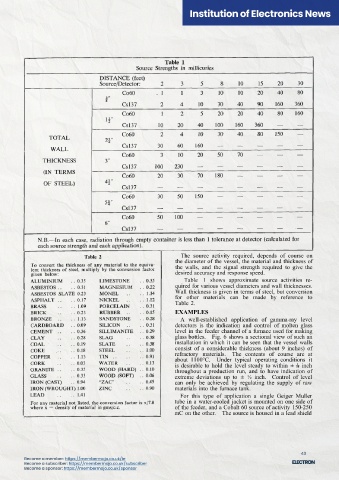
 that source and detector follow any changes in level and   .75  mR/hr.  Obviously,  all  steps  should be taken  to   The  source  activity  required,  depends  of  course on
 are  always  positioned  in  line with  the liquid  surface.   ensure that  the  actual  dose  received is below  this   the diameter of the vessel, the material and thickness of
 For a large vessel,  the main cost of such an installation   maximum permissible level.  A dose-rate  of 2.5 mR/hr.   the walls,  and  the signal  strength required  to give  the
 would  be in the mechanical hoisting gear and electrical   corresponds  to  about  250  counts/second in  a  typical
 drive.   Geiger Muller Tube for gamma-rays  from  Cobalt 60 or   desired accuracy and response speed.
                                                                  Table  1  shows  approximate source  activities  re-
 RELIABILITY   Caesium 137.  A  level detector  or level  indicator can,   quired for various vessel diameters and wall thicknesses.
 The Geiger  Muller  tubes  most  commonly  used as   therefore,  operate  satisfactorily with  a  dose-rate of   Wall thickness is given in terms of steel, but conversion
 detectors for level measurements are of the low voltage   about one tenth tolerance at the detector site.   for other  materials  can  be made  by  reference to
 Halogen-quenched  type.  These tubes,  made  almost   Source holders  are  designed  so  as to  surround the   Table 2.
 entirely of  metal,  are  extremely  robust  and  have a   source pellet with a shielding material (usually lead) on
 working life  which  is  independent  of the  number  of   all sides  except  for  a radiation  aperture  directed  to-   EXAMPLES
 pulses conducted.  In  practice  a  large  number of them   wards the detector.  Persons  are  not normally required   A well-established  application  of gamma-ray  level
 have  been in  continuous  use  for 4  or  5  years  without   to work  within  the  "beam"  from this aperture,  except   detectors is  the  indication  and control  of  molten  glass
 showing any signs of deterioration.  Their  temperature   beyond the detector,  where the intensity is  well  below   level in the feeder channel of a furnace used for making
 rating is  from  -55°C to  +70°C  so  that  they may  be   maximum permissible level.  Should it be necessary for   glass bottles.  Fig. 6 shows a sectional view of such an
 operated  at  the outside  of  many  industrial vessels   persons  to  work inside the vessel for maintenance pur-   installation in which it can be seen that the vessel walls
 without artificial cooling.  Water-cooled  detector units   poses, the  " beam ''  can  be  attenuated  drastically  by   consist of a considerable  thickness (about  9 inches)  of
 can, however, be provided where necessary.  The maxi-   closing  a  shutter  on  the  radiation  aperture.  The lead   refractory  materials.  The  contents  of course  are  at
 mum  pulse  rate of operation is  about  1000 counts/sec-   filling  in  the source  holder  ensures  that  the  radiation   about 1100°C.  Under  typical  operating  conditions  it
 ond  but,  in practice, the tubes are normally operated at   outside the  "beam," around  the  sides  and  back  of the   is desirable to  hold  the level steady to within  ±   inch
 about  100 counts/second or less.  Reliability  and  com-   holder is  below  the  maximum  permissible level  at  all   throughout a production  run,  and  to  have indication  of
 ponent life are thus  comparable  with  the best types  of   points  where  operators  may normally  work  or  stand   extreme  deviations  up  to  ±  ½  inch.  Control  of  level
 equipment employing electronic valves.   continuously.       can  only  be achieved  by  regulating the  supply of  raw
 There is always a small background level of radiation   In  practice it  is  found  that  source strengths  ranging   materials into the furnace tank.
 which  is detected  by a Geiger Muller tube and this can   from 0.5 to 250 mC are required, and the lead thickness   For  this  type  of  application  a  single  Geiger Muller
 be  used  to  operate a  fail-safe  system  in  many cases.   necessary  to  shield  these  may  range  from  1  inch  to 5   tube in a water-cooled  jacket is mounted on one side of
 For instance, if a ratemeter is used to indicate the level   inches.  The  source holder,  with  its  shutter  closed,   of the feeder, and a Cobalt 60 source of activity 150-250
 of liquid in a tank, the pulse signal can also be used to   forms  a  suitable  container  for transit  or  storage  of  the   mC on the other.  The source is housed in a lead shield
 energise an  alarm relay.  Under normal  working  con-   radio-active  source up to  the time of installation.

 33                                                        34


 42                                                                                                        43
 Become a member: https://membermojo.co.uk/ie  Become a member: https://membermojo.co.uk/ie
 Become a subscriber: https://membermojo.co.uk/subscriber  Become a subscriber: https://membermojo.co.uk/subscriber
 Become a sponsor: https://membermojo.co.uk/sponsor  Become a sponsor: https://membermojo.co.uk/sponsor

