


Page 26 - Spring Summer 2026
P. 26
Industry News                                                                                                                                                                                                    Industry News


            The cost-effective fabrication processes we used    may contribute to Alzheimer’s disease and whether
            in this new technology also have the potential to   targeted electrical stimulation can of specific neural
            deliver a scalable and affordable future treatment   circuits could provide therapeutic benefits.
            pathway which can be used in combination with
                                                                Dr. Samuel Barnes, Associate Professor in Neural
            other therapies.
                                                                Plasticity at the Department of Brain Sciences at
            Although there is still significant experimental work   Imperial College, comments:
            to be done before the system is ready to be used
                                                                   “ This is an exciting new technology addressing many
            directly in patient treatments, the results represent
                                                                   biological questions in a range of systems. We will first
            a significant step toward next-generation wireless
                                                                   use it to how Alzheimer’s disease-related pathology
            cancer therapies and implantable photonic medical
                                                                   impacts neurovascular dynamics and circuit
            devices. “
                                                                   interactions that were previously inaccessible with
          Reference: ‘Implantable Tech could cast new Light on Bladder Cancer   conventional in vivo imaging approaches. “
          Treatment’, Electronic Specifier, 23rd. May
                                                                Reference: ‘Wellcome awards £3.82m to Imperial Team for real-time
                                                                Brain Imaging Project’, New Electronics, Vol.59 Issue 4, April/May 2026,
          Imperial College London to develop new Brain          p.47
          Imaging System
          Researchers at Imperial College London have been      New Device helps Parkinson’s Patients to walk                    Why join the Institution of Electronics?
          awarded £3.92 million by Wellcome to develop a brain   A medtech entrepreneur, Jonathan Fisher, is using
          imaging system that can capture the electrical activity
                                                                £120,000 from Cambridge University to accelerate
          of thousands of neurons simultaneously in three       the development of ‘Peter’, a wearable device that is
          dimensions and in real-time.                                                                                           •  Corporate Members become                         •  Members are invited to “Coffee and
                                                                designed to help people suffering from Parkinson’s
          The team will develop a high-throughput imaging       disease to walk.                                                    people of letters, able to display                  Chat”, our regular virtual opportunity
          platform based on light-field microscopy, which aims                                                                      post nominal letters, being a useful                to chat with one another, regarding
          to overcome present day limits in scale and speed
                                                                                                                                    accreditation to show employers                     issues currently affecting them and
          associated with current in vivo brain imaging techniques.
                                                                                                                                    and others they are recognised for                  “Networking” with like-minded,
                                                                                                                                    their achievements.                                 experienced, people.


                                                                                                                                 •  The Institution of Electronics is one            •  Members can provide copy for
                                                                                                                                    of the oldest Institutions specifically             inclusion in Electron.
                                                                                                                                    for electronics engineers both
                                                                                                                                                                                     •  Student members can enter the
                                                                                                                                    professional and amateur.
                                                                                                                                                                                        National Electronics Competition.
                                                                                                                                 •  Members receive a copy of Electron
                                                                                                                                    published quarterly.


                                                                                                                                 •  Members have access to historic
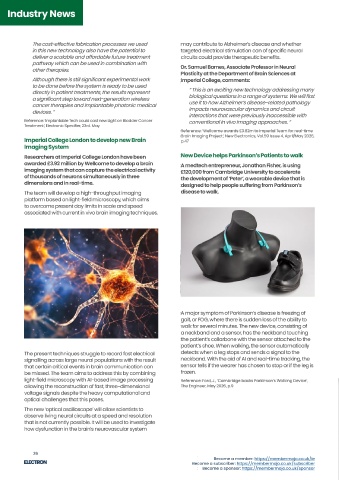
                                                                A major symptom of Parkinson’s disease is freezing of
                                                                gait, or FOG, where there is sudden loss of the ability to          publications on electronics.
                                                                walk for several minutes. The new device, consisting of
                                                                a neckband and a sensor, has the neckband touching
                                                                                                                                 •  Members can request on
                                                                the patient’s collarbone with the sensor attached to the
                                                                patient’s shoe. When walking, the sensor automatically              email address in the form
          The present techniques struggle to record fast electrical   detects when a leg stops and sends a signal to the            you@institutionofelectronics.ac.uk
          signalling across large neural populations with the result   neckband. With the aid of AI and real-time tracking, the
          that certain critical events in brain communication can   sensor tells if the wearer has chosen to stop or if the leg is
          be missed. The team aims to address this by combining   frozen.
          light-field microscopy with AI-based image processing   Reference: Ford, J., ‘Cambridge backs Parkinson’s Walking Device’,
          allowing the reconstruction of fast, three-dimensional   The Engineer, May 2026, p.9
          voltage signals despite the heavy computational and
          optical challenges that this poses.
          The new ‘optical oscilloscope’ will allow scientists to
          observe living neural circuits at a speed and resolution
          that is not currently possible. It will be used to investigate                                                         Become a
          how dysfunction in the brain’s neurovascular system
                                                                                                                                 member today...

                                                                                                                                 https://membermojo.co.uk/ie
             26                                                                                                                                                                                                                   27
                                                                            Become a member: https://membermojo.co.uk/ie         Become a member: https://membermojo.co.uk/ie
                                                                    Become a subscriber: https://membermojo.co.uk/subscriber     Become a subscriber: https://membermojo.co.uk/subscriber
                                                                        Become a sponsor: https://membermojo.co.uk/sponsor       Become a sponsor: https://membermojo.co.uk/sponsor

