


Page 37 - Spring 2025 Electron
P. 37
and  their  structure  is usually  more  uniform.  For  ex-   (iv)  Conducting  transparent  films  of  gold  and  of
                                                                    cadmium oxide are in use for electrically heated
 are thicker for a given order of  resistance value. They   ample, a  nickel  chromium film of  100 ohms/sq. would   windscreens  in cars  and  aeroplanes ,  for  pre-
         be only  about  100Å  units thick  compared  with a
                                                                                                    34
 are  also  usually  deposited under  conditions  which   cadmium oxide  film  of  1000Å  having  the same  resist-   venting the formation of  ice or mist.  These films
 ensure that  they  are partly  oxidised  during formation,   ance value.   are capable of operating up to about 180°C., the
 thus any further oxidation in the atmosphere is unlikely           best may have optical transparencies of  80% for
 unless the films are again raised to the high temperature   The choice of  substrate for the deposition of  conduct-   a  film  resistance  of  8-10 ohms/sq.  Conducting
 of  their formation, which is usually in excess of  300°C.   ing  films  for  resistance  coatings by  evaporation  or  by   glass is  being  produced  commercially  in Britain
 One can almost say that they are already protected  by   sputtering is  limited  to  certain  types  of  base  material.   and in the U.S.A.
 their  own  oxide layer.  Films  of  these alloys on  glass   In the  first place the  base must  either  be non-volatile,
 can  be  made  stable  to  within  ±½%  for  values  up  to   or  the  volatiles  must be  removable without  the base
 about  300-400  ohms per  square  and  deposited with   losing its mechanical properties.  It must also not con-   Electroluminescence
 about the same order of  accuracy.  Because of  the high   tain  so much volatile material  that the vacuum pumps   One very important application of  conducting highly
 temperature  of  deposition, the range of  base  materials   cannot  achieve  low pressures.  In spite of  this  limita-   transparent  films is  now  of  interest  to  electronic
 is  restricted to glass, quartz, mica  and other crystalline   tion many organic and inorganic materials are suitable.   engineers.
 bases.   If  one  requires  the  deposition  of  a  stable  conducting
 Reference has  already  been  made to  the use  of  thin   layer,  however,  the  base  must  also withstand  higher
 gold films  deposited  on  bismuth oxide  in  the  section   temperatures.  Stable  evaporated  films  are  limited
 dealing  with  cathode  sputtering, but  there  are  many   mainly to chromium alloys for which  the base must  be
 more combinations which  are of  use.  Gold, platinum   raised  to  at  least 300°C.  during  deposition, similarly
 CONSTANT CHARGE   and  silver have  all  been  deposited  between  different   during cathodic  sputtering  of  oxides  and  metals the
          base is  subjected to heavy ion  bombardment  with  con-
 ELECTROSTATIC LOUDSPEAKER   sandwich layers on glass with good results.  No figures   sequent increase  in  temperature. Glass,  quartz,  and
 are  yet  available  on  stability, but  it  seems  likely  that
 Figure  6d.   the upper  limit of  resistivity for stability is lower  than   certain  ceramics, have  been  used  preferentially,  but
 Basic arrangement of  an electrostatic loudspeaker for   for  the chromium  alloys,  probably  being  of  the order   some  success  has  also  been  achieved with  laminated
 high fidelity reproduction of  sound.   150 ohms per square.   glass cloth, bonded  with  special resins such as silicone,
 charge characteristics,  which  are  necessary  to avoid   Higher orders  of  resistivity may  be  obtained  by  the   epoxy, polyester, and melamine.
 non-linearity distortion.  It  is  interesting  to  note that   evaporation of carbon films or certain semi-conducting   Tests  on  the  stability  of  films  deposited  on  various
 the high resistance may be incorporated in the conduct-   oxides  such as iron  oxide or  chromium oxide, but  the   organic substrates as opposed  to glass are being carried
 ing coating itself.  Authorities  on  the  subject 31, 32   have   most  promising technique  for  semi-conducting  oxide   out  in  our  laboratories.  An  upward  drift  is  apparent
 pointed  out that this would ease the problem of  match-   and  nitride production  is  Reactive Sputtering.   The   in many of  the films, but some are showing promise of
 ing  the  output  to  a  capacitive load  by  providing   importance  of  this technique  lies  in the  fact  that  the   stability. Nickel-chromium  alloy deposited  on  glass
 distributed resistance  and  capacity, thus  giving some   conductivity  of  a particular  oxide  film  can  be  varied   laminates is already on the market in the United  States
 characteristics of  a  transmission  line with  much  more   repeatedly over  quite  wide  limits  by  control  of  the   and  high stability is claimed.  It has the  advantage of
 constant impedance.   amount of  oxygen in the otherwise inert atmosphere of   flexibility,  and  can also  be  punched  and  stamped  out
 e 0
 An  apparatus  has  been  made to  demonstrate  the   the  glow  discharge .  For  example,  when  sputtering   into odd shapes. Colloidal silver contacts are provided,
          and the film is claimed to be protected.  It is produced
 simple  construction  of  an  electrostatic speaker  for   cadmium oxide, if  pure oxygen is used in the discharge,   by Filmohm Corporation, New York.   ELECTROLUMINESCENT  PAN EL
 the resultant  film is  almost completely non-conducting,
 treble  response;  it  consisted  of  aluminised  " Melinex "   but if  a mixture of 5% oxygen 95% argon is used, films
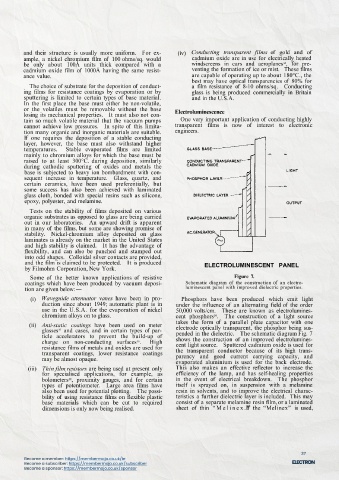
 stretched across  a  perforated grid.  The  speaker  was   of  100 ohms per square may be readily produced, and   Some  of  the  better  known  applications  of  resistive   Figure  7.
 energised by  a  small transistor  oscillator delivering 1.5   by  varying the  concentration  of  oxygen, the  resistance   coatings which  have been  produced  by vacuum deposi-   Schematic  diagram  of  the construction of  an electro-
 watts from  three  pocket  torch batteries.  The  output   of  a  film  of  the  same order  of  thickness, i.e.,  about   tion are given below:-   luminescent panel with improved dielectric properties.
 was of  the order 300V r.m.s. at  1.5 kc/s and the sound   1000Å,  may be progressively increased  up to the value   Waveguide attenuator  vanes  have been  in pro-
 was  sufficient to fill  a medium  sized lecture hall.  The   of  several megohms.  Similar effects are observed with   (i)   Phosphors have  been  produced  which  emit light
 demonstration  only serves to  illustrate  the  basic prin-   the oxides of  tin and indium, but the values are not so   duction  since  about  1949;  automatic plant  is  in   under the influence of  an alternating field of  the order
 ciple of  the  electrostatic loudspeaker,  yet  it  is  certain   repeatable.  Unfortunately  cadmium oxide  films  have   use  in the U.S.A.  for the evaporation  of  nickel   50,000 volts/cm.  These  are  known  as  electrolumines-
                                                                            39
 that now plant is available for the continuous aluminis-   to be protected against acid atmospheres, but this may   chromium alloys on to glass.   cent phosphors .  The construction  of  a  light  source
 ing  of  " Melinex "  then  the  electrostatic  speaker in  its   be done quite easily by means of  another evaporated or   (ii)  Anti-static  coatings  have been  used  on  meter   takes  the form  of  a  parallel plate  capacitor  with  one
 most  refined  form becomes  a  commercial probability.   sputtered  dielectric layer or by  a  protective layer of  a   glasses and  cases,  and in  certain types  of  par-   electrode optically transparent, the phosphor being sus-
                     37
                                                               pended in the dielectric.  The schematic diagram Fig. 7
 resin based  lacquer.   ticle accelerators  to  prevent  the  build-up  of   shows the construction  of  an improved  electrolumines-
 Resistive  Coatings   Preliminary  experiments on  the  stability  of  unpro-   charge  on  non-conducting surfaces .   High   cent light source.  Sputtered cadmium oxide is used for
                                                 36
                resistance films of metals and oxides are used for
 Before discussing specific examples of  resistive coat-   tected cadmium oxide films show that there is an initial   transparent  coatings,  lower resistance  coatings   the  transparent conductor  because  of  its  high  trans-
 ings, let us first consider the basic limitation.   ageing effect in  which  the resistance decreases by  8%   may be almost opaque.   parency  and  good  current  carrying capacity,  and
                                                               evaporated aluminium  is  used  for the  back  electrode.
 Metal  films  having  a  useful  order  of  resistance are   during  the  first week,  thereafter there  is  a gradual in-   (iii)  Thin film resistors are being used at present only   This  also  makes  an  effective reflector  to  increase the
 usually so thin that they are completely unstable, partly   crease in  resistance  of  up  to 5%  after  a  period  of  3   for  specialised  applications,  for  example,  as   efficiency  of  the lamp,  and  has  self-healing  properties
 due  to  atmospheric oxidation  and  partly  due  to their   months.  Data  cannot  be found  for  other  oxides  but   bolometers ,  proximity gauges,  and for  certain   in  the  event  of  electrical breakdown.  The  phosphor
                         38
 inherent granular  structure.  Some  exceptions to  this   there is every reason  to  suppose that  they  are at least   types  of  potentiometer.  Large  area  films  have   itself  is  sprayed  on,  in  suspension with  a  melamine
 are special high resistance alloys containing nickel and   as  stable  as  cadmium oxide.  The  given figures  for   also been used for potential plotting.  The possi-   resin  in solvents,  and  to improve the  electrical  charac-
 chromium and some noble metals when sandwiched   cadmium  oxide refer  to  unprotected  films.  Cadmium   bility  of  using resistance  films on flexible plastic   teristics a further dielectric layer is included.  This may
 34
 33
 between protective layers.   oxide is known to be subject to atmospheric deteriora-   base materials  which  can  be  cut  to  required   consist of  a separate melamine resin film, or a laminated
 tion so that protection might be expected to give better
                                                                                       If
 The alloys containing nickel  and  chromium already   results.   Oxide  films  give  more  promise  of  stability   dimensions is only now being realised.   sheet  of  thin  “ M e l i n e x . ”  the  “Melinex”  is  used,
 have  a  higher bulk  resistivity,  and  therefore the  films   than metal  films  because  they  are  very  much  thicker
                                                            41
 40
 36                                                                                                        37
 Become a member: https://membermojo.co.uk/ie  Become a member: https://membermojo.co.uk/ie
 Become a subscriber: https://membermojo.co.uk/subscriber  Become a subscriber: https://membermojo.co.uk/subscriber
 Become a sponsor: https://membermojo.co.uk/sponsor  Become a sponsor: https://membermojo.co.uk/sponsor

