


Page 32 - Spring 2025 Electron
P. 32
When used in conjunction with reactive sputtering first bismuth oxide layer is to increase the adhesion of
design. The vertical chamber itself is 19 inches in restricted to oxides so that films of nitrides , hydrides this new technique has many useful applications the gold to the glass and to prevent the migration of
21
diameter and can be hydraulically raised and lowered. and sulphides have also been prepared by similar the gold into aggregates during deposition. The top
The chamber accessories include a turret head of six methods. Sputtering of pure metals in an inert gas layer of oxide protects the gold from abrasion. A
evaporation sources, apparatus for discharge cleaning such as argon, is used only for the deposition of the simple comparison can be made between gold deposited
and radiant heating, a modulated beam photometer for noble metals gold, palladium, platinum, etc. Gold films on plain glass and on the bismuth oxide coated glass.
monitoring optical coatings, a rotating workholder, and deposited on quartz crystals for frequency control, and Visual observation of the transmission colour of the
a shuttering system over the sources. for contacts on other sensitive elements may be sput- plain gold film to white light show the characteristic
tered in air or in an inert gas. blue-green absorption colour of gold which is due to
An improved system of cathodic sputtering has been
Cathode Sputtering developed 22 which is very successful and is likely to the presence of aggregates of atoms. On the other
hand, the gold on bismuth oxide has a pale straw
In the physical process of sputtering, metal atoms are become very important. In conventional sputtering transmission colour suggesting a much less grainy
released from a surface under positive ion bombard- technique a glow discharge is set up using a d.c. system structure. This is confirmed by electron microscopy-.
ment. In practice, a glow discharge operating in the between an anode and a cathode immersed in the gas The properties of the gold film closely resemble those
abnormal region is used as a convenient source of at low pressure; positive ions bombard the cathode and of the bulk material.
positive ions. A potential of a few thousand volts is the sputtered metal drifts through the gas to land on all The sputtering rate may depend upon the following
applied between an anode and cathode immersed in a surfaces near the cathode. A diagram of the new variables:--
gas at a pressure usually in the range of 10-100 microns system is shown in Fig. 2.
Hg. (.01 to 0.1 mm. Hg.). The positive ions, formed (i) Molecular weight of the sputtering gas.
by electrons colliding with gas molecules, bombard the (ii) ion current density.
cathode and metal atoms are ejected. These atoms (iii) Energy of the incident ions.
travel through the discharge, condensing on the cham- (iv) Cathode temperature.
ber walls and fittings, many returning to the cathode
itself, having undergone collisions with gas molecules. (v) Gas density.
The behaviour of the metal vapour can best be ex- (vi) Work function of the cathode surface.
plained as a diffusion process, and recent work 13 has Cathodic sputtering in a glow discharge is therefore
shown that diffusion theory can be applied to predict
the movement of the sputtered metal particles in the very dependent on the condition of the discharge. and
discharge. The mechanism by which metal atoms are the sputtering rate can vary over very wide limits.
removed from the cathode has been the subject of con-
jecture and argument for many years. The theories Gas Plating
developed fall into two groups, firstly that the effect was This technique can be used for the deposition of
due to a direct momentum transfer of energy from the materials which are normally difficult to evaporate or
incident positive ion to the ejected atom . The second sputter, for example, nickel, molybdenum, and tung-
14
theory assumed that the energy of the positive ion was sten. The process is a chemical one 24, 25 , in which the
used in producing intense local heating, causing thermal Figure 3. metal is introduced into the chamber in gaseous form,
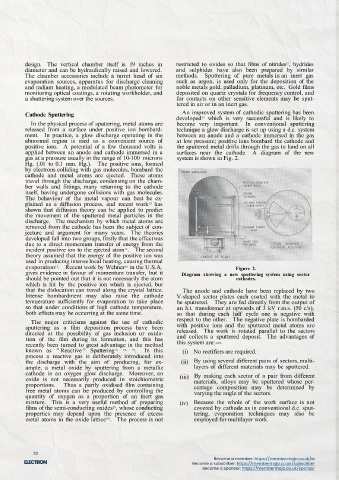
evaporation . Recent work by Wehner in the U.S.A. Figure 2. View of a plant for sector sputtering and evaporation. for example as a carbonyl at about 1 mm. pressure.
16
15
gives evidence in favour of momentum transfer, but it Diagram showing a new sputtering system using sector Hydrogen is mixed with the carbonyl and reaction takes
should be pointed out that it is not necessarily the atom cathodes. Fig. 3 shows a photograph of the work chamber of place at hot surfaces upon which the metal coating is
which is hit by the positive ion which is ejected, but an experimental plant which has been developed for deposited by reduction of the carbonyl. Temperatures
that the dislocation can travel along the crystal lattice. The anode and cathode have been replaced by two laboratory and small scale production use. The water of 500-800°C. are required, so that the process is limited
Intense bombardment may also raise the cathode V-shaped sector plates each coated with the metal to cooled sector sputtering plates. and turret head of four in application, and requires special apparatus. Never-
temuerature sufficiently for evaporation to take place be sputtered. They are fed directly from the output of evaporation sources can be clearly seen. The rotary theless it is worthy of mention since it is extensively
so that under conditions of high cathode temperature, an h.t. transformer at upwards of 3 kV r.m.s. (50 c/s), work holder is rim driven and maintains a constant used in a modified form for the production of high
both effects may be occurring at the same time. so that during each half cycle one is negative with speed of about 30 r.p.m. thus ensuring uniform deposi- stability resistors by the reduction of hydrocarbons to
The major criticisms against the use of cathodic respect to the other. The negative plate is bombarded tion over the whole of the work area. This assembly obtain a deposit of carbon on ceramic tube.
would normally be covered by a 12 inch diameter
sputtering as a film deposition process have been with positive ions and the sputtered metal atoms are " Pyrex " glass bell jar. In its widest sense, pyrolitic plating is not strictly a
directed at the possibility of gas inclusion or oxida- released. The work is rotated parallel to the sectors vacuum technique, but many of its applications are
and collects a sputtered deposit. The advantages of
tion of the film during its formation, and this has A prototype, of 3 feet diameter, combined sputtering carried out at pressures obtainable by means of a rotary
recently been turned to great advantage in the method this system are:- and evaporation plant has also been developed and has pump.
known as " Reactive " Sputtering 17, 18, 19 . In this (i) No rectifiers are required. been used for uniform deposition on to plates of 30
process a reactive gas is deliberately introduced into inches diameter. A typical application of this plant SOME IMPORTANT APPLICATIONS OF
the discharge with the aim of producing, for ex- (ii) By using several different pairs of sectors, multi- lies in the production of glass with a highly conducting VACUUM DEPOSITION
ample, a metal oxide by sputtering from a metallic layers of different materials may be sputtered. surface. The coating may consist of the following
cathode in an oxygen glow discharge. Moreover, an (iii) By making each sector of a pair from different layers:- Aluminising of Cathode Ray Tubes
oxide is not necessarily produced in stoichiometric materials, alloys may be sputtered whose per- (i) Reactively sputtered bismuth oxide. This application is probably the most familiar one to
proportions. Thus a partly oxidised film containing centage composition may be determined by electronic engineers, and is firmly established as a
free metal atoms can be produced by controlling the varying the angle of the sectors. (ii) Evaporated gold. standard technique. Mass production can be carried
quantity of oxygen as a proportion of an inert gas (iii) Reactively sputtered bismuth oxide. out, and rotary aluminising units have been made with
mixture. This is a very useful method of preparing (iv) Because the whole of the work surface is not The result being a conducting coating which is very multiple pumping and evaporation heads. Before the
films of the semi-conducting oxides , whose conducting covered by cathode as in conventional d.c. sput- durable, and which has a high optical transparency and gun assembly is fitted, the tube is given its phosphor
20
properties may depend upon the presence of excess tering, evaporation techniques may also be a very low surface resistance . The function of the screen which is covered with a layer of nitro-cellulose.
23
metal atoms in the oxide lattice . The process is not employed for multilayer work.
35
37
36
32 33
Become a member: https://membermojo.co.uk/ie Become a member: https://membermojo.co.uk/ie
Become a subscriber: https://membermojo.co.uk/subscriber Become a subscriber: https://membermojo.co.uk/subscriber
Become a sponsor: https://membermojo.co.uk/sponsor Become a sponsor: https://membermojo.co.uk/sponsor

