


Page 9 - Autumn 2024
P. 9
Industry News


          MORE QUANTUM

          DEVELOPMENTS


          First Full-stack Silicon CMOS Quantum                 architecture which integrates all the required
          Computer                                              compute, readout, and control elements into a dense
                                                                array that can be repeatedly printed onto a chip,
          Quantum Motion has developed the industry’s first
                                                                enabling future expansion to millions of qubits per
          full-stack quantum computer to be built using a
                                                                QPU. The system also represents a breakthrough in
          standard silicon CMOS chip fabrication process, the
                                                                AI machine learning tuning, enabling more efficient
          same transistor technology used in conventional
                                                                operation and automated algorithms for control and
          computers.
                                                                calibration.
                                                                Reference: Colby, T., ‘Quantum Motion’s First Full-stack Silicon CMOS
                                                                Quantum Computer’, Electronic Specifier, 15th. September

                                                                Qubic to develop Advanced Quantum
                                                                Amplifier Technology

                                                                Qubic, a quantum technology company pioneering
                                                                advanced radar and cryogenic amplifiers, has been
                                                                awarded a $925,000 (CAD) grant from the Canadian
                                                                government to support a $2.5 million project to
                                                                develop cryogenic amplifiers made from quantum
                                                                materials. This will help overcome thermal barriers
                                                                that are currently impeding the development of
                                                                quantum computers.
                                                                Most quantum computers perform operations in
                                                                a cryogenic environment. The heat generated by
                                                                the system’s electronics typically requires extra
                                                                cooling, potentially disrupting the cryogenics used
                                                                in quantum systems and limiting the number of
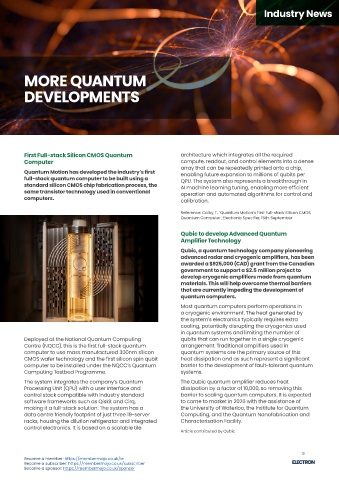
          Deployed at the National Quantum Computing            qubits that can run together in a single cryogenic
          Centre (NQCC), this is the first full-stack quantum   arrangement. Traditional amplifiers used in
          computer to use mass manufactured 300nm silicon       quantum systems are the primary source of this
          CMOS wafer technology and the first silicon spin qubit   heat dissipation and as such represent a significant
          computer to be installed under the NQCC’s Quantum     barrier to the development of fault-tolerant quantum
          Computing Testbed Programme.                          systems.
          The system integrates the company’s Quantum           The Qubic quantum amplifier reduces heat
          Processing Unit (QPU) with a user interface and       dissipation by a factor of 10,000, so removing this
          control stack compatible with industry standard       barrier to scaling quantum computers. It is expected
          software frameworks such as Qiskit and Cirq,          to come to market in 2026 with the assistance of
          making it a full-stack solution. The system has a     the University of Waterloo, the Institute for Quantum
          data centre friendly footprint of just three 19-server   Computing, and the Quantum Nanofabrication and
          racks, housing the dilution refrigerator and integrated   Characterisation Facility.
          control electronics. It is based on a scalable tile
                                                                Article contributed by Qubic


                                                                                                           9
          Become a member: https://membermojo.co.uk/ie
          Become a subscriber: https://membermojo.co.uk/subscriber
          Become a sponsor: https://membermojo.co.uk/sponsor

