


Page 11 - Autumn 2024
P. 11
First continuously operating Quantum                  This is the first time that a quantum computer has
          Computer                                              successfully executed an algorithm the results of
                                                                which have been able to be independently verified
          Scientists at Harvard University have built the
                                                                and repeated - a major step towards the practical
          first ever quantum computer that can operate
                                                                deployment of quantum hardware in scientific
          continuously without restarting. This is viewed
                                                                applications.
          as being a breakthrough since most quantum
          computers can only run for milliseconds and even
                                                                Quantum verification refers to the ability to reproduce
          the advanced machines have so far only operated
                                                                a result on another quantum system of comparable
          for around 13 seconds.
                                                                capability, confirming that a computation is both
                                                                correct and scalable. This has been a long-standing
                                                                challenge owing to the fact that quantum states are
                                                                fragile and error-prone.
                                                                The Willow chip has an architecture that significantly
                                                                reduces quantum error rates and the Quantum
                                                                Echoes technique has been likened to sending
                                                                a signal to a quantum system then reversing it
                                                                to capture a return ‘echo’. This echo is enhanced
                                                                by constructive interference between quantum
                                                                waves, which provides an exceptionally sensitive
                                                                measurement for more accurate and complex
                                                                simulations.


          A major problem in quantum is the so-called ‘atomic
          loss’, where qubits effectively escape from the system
          causing it to lose information and ultimately fail. In
          order to address this the Harvard team deployed two
          tools that can move atoms and subatomic particles,
          basically an “optical lattice conveyor belt” and a pair
          of “optical tweezers” which act so as to replenish
          qubits as they escape. Up to 300,000 atoms per
          second can be input to the machine, compensating
          for the ‘atomic loss’.

          Research Associate Tout T. Wang, who was involved in
          designing the machine, comments:
                                                                In collaboration with the University of California,
          “There’s now fundamentally nothing limiting how long
                                                                Berkeley, Google demonstrated how Quantum
          our usual atom and quantum computers can run for.
                                                                Echoes can be applied notably to chemical research
          Even if atoms get lost with a small probability, we can
                                                                by analysing the structure of two molecules
          bring fresh atoms in to replace them and not affect
                                                                containing 15 and 28 atoms respectively. The
          the quantum information being stored in the system”.
                                                                quantum-derived results matched those of Nuclear
                                                                Magnetic Resonance (NMR) measurements as
          Reference: ‘Researchers develop continuously operating Quantum
          Computer’, New Electronics, Vol.58, Issue 9, October 2025, p.7  well as revealing additional information that is
                                                                fundamentally inaccessible with traditional NMR. This
                                                                proof-of-concept experiment therefore pointed to a
          Quantum Processor outperforms                         tool that could reveal molecular and atomic-scale
          Supercomputers by 13,000 Times                        phenomena that is currently beyond the reach of
                                                                existing instruments.
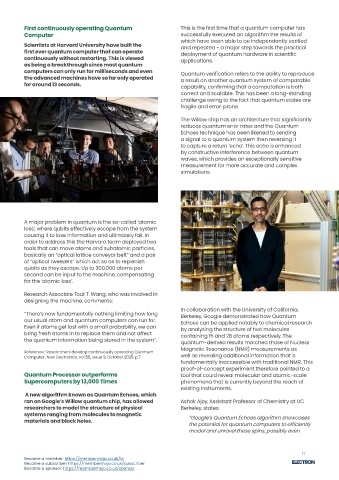
           A new algorithm known as Quantum Echoes, which
          ran on Google’s Willow quantum chip, has allowed      Ashok Ajoy, Assistant Professor of Chemistry at UC
          researchers to model the structure of physical        Berkeley, states:
          systems ranging from molecules to magnetic
                                                                   “Google’s Quantum Echoes algorithm showcases
          materials and black holes.
                                                                   the potential for quantum computers to efficiently
                                                                   model and unravel these spins, possibly even


                                                                                                           11
          Become a member: https://membermojo.co.uk/ie
          Become a subscriber: https://membermojo.co.uk/subscriber
          Become a sponsor: https://membermojo.co.uk/sponsor

