


Page 18 - Autumn 2024
P. 18
Industry News


          CORNELL UNIVERSITY

          BUILDS MICROWAVE


          BRAIN ON A CHIP


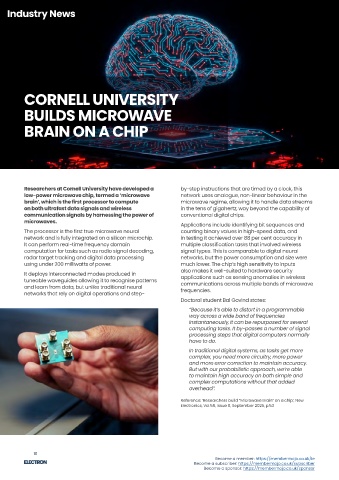
          Researchers at Cornell University have developed a    by-step instructions that are timed by a clock, this
          low-power microwave chip, termed a ‘microwave         network uses analogue, non-linear behaviour in the
          brain’, which is the first processor to compute       microwave regime, allowing it to handle data streams
          on both ultrafast data signals and wireless           in the tens of gigahertz, way beyond the capability of
          communication signals by harnessing the power of      conventional digital chips.
          microwaves.
                                                                Applications include identifying bit sequences and
          The processor is the first true microwave neural      counting binary values in high-speed data, and
          network and is fully integrated on a silicon microchip.   in testing it achieved over 88 per cent accuracy in
          It can perform real-time frequency domain             multiple classification tasks that involved wireless
          computation for tasks such as radio signal decoding,   signal types. This is comparable to digital neural
          radar target tracking and digital data processing     networks, but the power consumption and size were
          using under 200 milliwatts of power.                  much lower. The chip’s high sensitivity to inputs
                                                                also makes it well-suited to hardware security
          It deploys interconnected modes produced in
                                                                applications such as sensing anomalies in wireless
          tuneable waveguides allowing it to recognise patterns
                                                                communications across multiple bands of microwave
          and learn from data, but unlike traditional neural
                                                                frequencies.
          networks that rely on digital operations and step-
                                                                Doctoral student Bal Govind states:
                                                                   “Because it’s able to distort in a programmable
                                                                   way across a wide band of frequencies
                                                                   instantaneously, it can be repurposed for several
                                                                   computing tasks. It by-passes a number of signal
                                                                   processing steps that digital computers normally
                                                                   have to do.
                                                                   In traditional digital systems, as tasks get more
                                                                   complex, you need more circuitry, more power
                                                                   and more error correction to maintain accuracy.
                                                                   But with our probabilistic approach, we’re able
                                                                   to maintain high accuracy on both simple and
                                                                   complex computations without that added
                                                                   overhead”.

                                                                Reference: ‘Researchers build “Microwave Brain” on a chip’, New
                                                                Electronics, Vol.58, Issue 8, September 2025, p.53


             18
                                                                             Become a member: https://membermojo.co.uk/ie
                                                                     Become a subscriber: https://membermojo.co.uk/subscriber
                                                                         Become a sponsor: https://membermojo.co.uk/sponsor

