


Page 31 - Winter 2026
P. 31
y N
 t
 s
 w
 r
 e
 I
 Industry Newss                                                                               Industry News
 nd
 u


 NEW FORM OF

 GRAPHENE EXHIBITS   DEVELOPMENTS

 SUPERCONDUCTIVITY  IN ROBOTICS


 Scientists at the Massachusetts Institute of   Ordinary superconductors allow a current to flow   World’s smallest programmable    These reduced power consumption by a factor of a
 Technology (MIT) have discovered that a special   through them with no resistance, but only at very   Autonomous Robots  thousand, whilst condensing what traditionally would
 form of graphene, produced by stacking ultra-thin   low temperatures, that is to say cryogenically. This   require many instructions for propulsion control
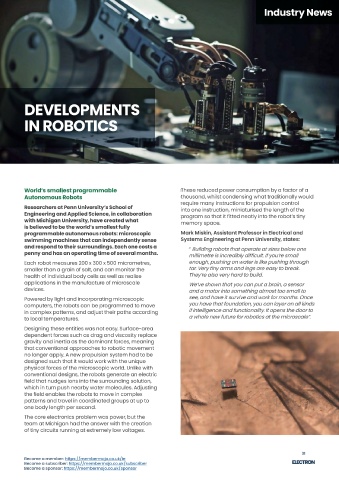
          Researchers at Penn University’s School of
 layers of carbon at a specific angle, can conduct   necessitates powerful cooling systems typically   into one instruction, miniaturised the length of the
          Engineering and Applied Science, in collaboration
 electricity in a completely new way without wasting   deploying liquid helium or liquid nitrogen, making them   program so that it fitted neatly into the robot’s tiny
          with Michigan University, have created what
 any energy.  difficult to use other than in very specialised settings.  memory space.
          is believed to be the world’s smallest fully
 Studies of superconductivity typically involve   programmable autonomous robots: microscopic   Mark Miskin, Assistant Professor in Electrical and
 measurement of the superconducting gap to   swimming machines that can independently sense   Systems Engineering at Penn University, states:
 determine how stable the superconducting state is,   and respond to their surroundings. Each one costs a   “ Building robots that operate at sizes below one
 and in the MIT case an experimental platform was   penny and has an operating time of several months.  millimetre is incredibly difficult. If you’re small
 constructed that combined the two well-established
          Each robot measures 200 x 300 x 500 micrometres,         enough, pushing on water is like pushing through
 techniques of tunnelling spectroscopy, which examines
          smaller than a grain of salt, and can monitor the        tar. Very tiny arms and legs are easy to break.
 how electrons ‘tunnel’ through barriers, and electrical
          health of individual body cells as well as realise       They’re also very hard to build.
 transport, which measures resistance as current flows.
          applications in the manufacture of microscale
 This method enabled clearer visibility of the MATTG               We’ve shown that you can put a brain, a sensor
          devices.
 superconducting gap and confirmed that it was                     and a motor into something almost too small to
 present only when the material had zero resistance.  Powered by light and incorporating microscopic   see, and have it survive and work for months. Once
          computers, the robots can be programmed to move          you have that foundation, you can layer on all kinds
                                                                   if intelligence and functionality. It opens the door to
          in complex patterns, and adjust their paths according
 Analysis showed that whilst ordinary superconductors   to local temperatures.  a whole new future for robotics at the microscale”.
 exhibited a flat shape, the MATTG had a sharp
          Designing these entities was not easy. Surface-area
 V-shaped profile, signalling that the material was
          dependent forces such as drag and viscosity replace
 indeed an unconventional superconductor.
          gravity and inertia as the dominant forces, meaning
 In superconductors electrons move in pairs, known as   that conventional approaches to robotic movement
 The phenomenon, which derives from the material’s
 Cooper Pairs, rather than individually. The above results   no longer apply. A new propulsion system had to be
 superconductivity, potentially allows for the
 suggested that the electrons were pairing in a different   designed such that it would work with the unique
 construction of super-efficient power systems and
 way to that normally expected. Now, scientists can   physical forces of the microscopic world. Unlike with
 faster computers.
 observe how superconductivity emerges in real-time   conventional designs, the robots generate an electric
 In ordinary superconductors, electrons pair up through   with a direct view of how electrons pair and interact   field that nudges ions into the surrounding solution,
 vibrations in the atomic lattice, but in this ‘magic-  with other quantum states, opening the door to the   which in turn push nearby water molecules. Adjusting
 angle twisted tri-layer graphene’ , referred to as MATTG,   design of superconductors that operate under normal   the field enables the robots to move in complex
 the pairs are apparently bound together a lot more   conditions.  patterns and travel in coordinated groups at up to
 tightly, and by studying this it is hoped that so-called   one body length per second.
 Reference: Miles, S., ‘Unconventional Superconductivity in Magic-
 ‘unconventional superconductivity’ will enable the   angle Graphene’, Electronic Specifier, 20th. November.
          The core electronics problem was power, but the
 design of materials that work at higher temperatures,
          team at Michigan had the answer with the creation
 creating new possibilities for quantum computing and
          of tiny circuits running at extremely low voltages.
 advanced sensors.
 30                                                                                                        31
 Become a member: https://membermojo.co.uk/ie  Become a member: https://membermojo.co.uk/ie
 Become a subscriber: https://membermojo.co.uk/subscriber  Become a subscriber: https://membermojo.co.uk/subscriber
 Become a sponsor: https://membermojo.co.uk/sponsor  Become a sponsor: https://membermojo.co.uk/sponsor

