


Page 17 - Winter 2025
P. 17
Industry News                                                                                Industry News


          FOCUS ON
 REVOLUTIONARY
          OPTOELECTRONICS
 STICKER TO MONITOR


 BREATHING


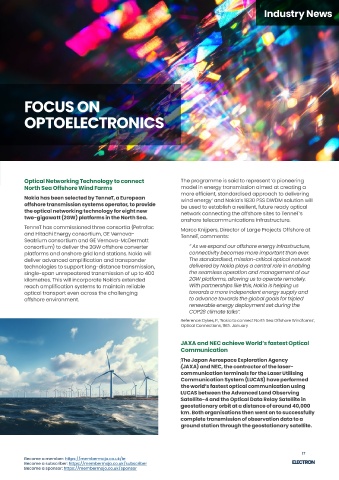
          Optical Networking Technology to connect              The programme is said to represent ‘a pioneering
          North Sea Offshore Wind Farms                         model in energy transmission aimed at creating a
                                                                more efficient, standardised approach to delivering
          Nokia has been selected by TenneT, a European
                                                                wind energy’ and Nokia’s 1830 PSS DWDM solution will
 A new wearable ‘sticker’ that can accurately   ability to continuously measure respiration in this   offshore transmission systems operator, to provide
                                                                be used to establish a resilient, future ready optical
 monitor and detect changes in a person’s   way gives us the potential to enable faster, more   the optical networking technology for eight new
                                                                network connecting the offshore sites to TenneT’s
 breathing, even when not in direct contact with   effective treatment, significantly enhancing patient   two-gigawatt (2GW) platforms in the North Sea.
                                                                onshore telecommunications infrastructure.
 the skin, has been developed by scientists from   outcomes and operational efficiency within the
          TenneT has commissioned three consortia (Petrofac
 Nottingham Trent University, the University of   health service”.  Marco Knijpers, Director of Large Projects Offshore at
          and Hitachi Energy consortium, GE Vernova-
 Southampton and University Hospital Southampton                TenneT, comments:
 Professor Neil White, Director of the Centre for   Seatrium consortium and GE Vernova-McDermott
 in collaboration with med-tech company Zelemiq
 Healthcare at the University of Southampton,   consortium) to deliver the 2GW offshore converter   “ As we expand our offshore energy infrastructure,
 Limited.                                                          connectivity becomes more important than ever.
 comments:  platforms and onshore grid land stations. Nokia will
 Changes in breathing rate can often be an early   deliver advanced amplification and transponder   The standardised, mission-critical optical network
 “ This wearable technology allows the
 warning sign of respiratory diseases, including sepsis   technologies to support long-distance transmission,   delivered by Nokia plays a central role in enabling
 measurement of respiratory rate over long periods
 and Covid-19, but currently it still requires nurses to   single-span unrepeatered transmission of up to 400   the seamless operation and management of our
 of time, which is not achievable using conventional
 manually count the number of breaths per minute, a   kilometres. This will incorporate Nokia’s extended   2GW platforms, allowing us to operate remotely.
 manual breath counting. Trends in respiratory rate
 slow method that can introduce delays to detecting   reach amplification systems to maintain reliable   With partnerships like this, Nokia is helping us
 can therefore be recorded and observed, offering
 changes and providing treatment.  optical transport even across the challenging   towards a more independent energy supply and
 the potential for rapid interventions that can
          offshore environment.                                    to advance towards the global goals for tripled
 The new device, known as the Pneumorator, contains   potentially save lives”.  renewable energy deployment set during the
 a series of functional layers and works by measuring
 Dr. Harry Aberman, a consultant anaesthetist at                   COP28 climate talks”.
 the frequency variation of the sensor that is induced
 University Hospital Southampton, adds further:                 Reference: Dykes, P., ‘Nokia to connect North Sea Offshore Windfarms’,
 by breathing, enabling the accurate detection of
                                                                Optical Connections, 15th. January
 subtle variations  resulting from chest expansion or   “ Respiratory rate is often the first physiological
 changes in lung composition. Tests showed that the   parameter to change as the patient is becoming
 device was able to measure a respiratory rate to   unwell - ahead of changes in heart rate, blood   JAXA and NEC achieve World’s fastest Optical
 within an accuracy of two breaths per minute.  pressure, temperature and oxygen levels. It is also   Communication
 the only one of these that is routinely measured
 It is intended that the device will be wirelessly              The Japan Aerospace Exploration Agency
 manually and so is susceptible to human error.
 interfaced to display data onto a dedicated                    (JAXA) and NEC, the contractor of the laser-
 smartphone or tablet app so that healthcare   We know that earlier detection of diseases is better   communication terminals for the Laser Utilising
 professionals can gain an early warning of declining   for patients whilst also being cheaper to treat, so   Communication System (LUCAS) have performed
 health.  a device that continuously and non-invasively         the world’s fastest optical communication using
 measures respiratory rate could be a great tool in             LUCAS between the Advanced Land Observing
 Dr. Yang Wei, specialist in electronic textiles and
 the early detection of deteriorating patients”.                Satellite-4 and the Optical Data Relay Satellite in
 electronic engineering at Nottingham Trent University,
 says:  Reference: West, P., ‘First of its Kind “Sticker” can monitor Breathing’,   geostationary orbit at a distance of around 40,000
 Electronic Specifier, 14th. December                           km. Both organisations then went on to successfully
 “ This is a groundbreaking wearable innovation                 complete transmission of observation data to a
 meticulously developed to provide crucial support              ground station through the geostationary satellite.
 for patients and healthcare professionals. The
 16                                                                                                        17
 Become a member: https://membermojo.co.uk/ie  Become a member: https://membermojo.co.uk/ie
 Become a subscriber: https://membermojo.co.uk/subscriber  Become a subscriber: https://membermojo.co.uk/subscriber
 Become a sponsor: https://membermojo.co.uk/sponsor  Become a sponsor: https://membermojo.co.uk/sponsor

