


Page 31 - Summer 2024
P. 31
ties  of  hydrogen  in  the  molecular  or combined  state,   in  dispersion  before a  sufficiently high  tolerance  level
 adhering  to  the walls.  Tritium  can  very quickly   is reached.
 exchange with such hydrogen, causing contamination of   It is recommended, however, that source stores should
 the  counter  and  inability  to  regain  the  normal  back-   be  well  ventilated  to  prevent  a  build  up  of concentra-
 ground count.  During  the  past  few years  various   tion  of  the radioisotopes,  in  the event  of  a  leakage.
 techniques have  been  evolved for  counteracting  this
 contamination  effect,  such  as  converting  the tritium  to   PREPARATION, HANDLING AND COST
 a  saturated  organic  gas  and  using  this  as  the counter   (a)  Tritium
 gas filling.  Detection devices or monitors are invariably   Tritium  is  formed  by  irradiating lithium  compounds
 large  capacity  ionization  chambers  into  which  tritium   in  thermal  reactors,  and extracting  and purifying  the
 vapour  can diffuse  with  laboratory  air,  or be  pumped   gas  at  high  temperatures  using  high vacuum  glass
 through  by  means  of  a  simple  venturi pump operated   apparatus 1, 3 . Multi-curie  quantities  can be  handled
 from a  compressed  air supply.  Standard  ß/  monitors   with ease in fume cupboards connected to  a  substantial
 can  be  modified  to  operate on  the latter principle.   air  extract  system,  which  will  prevent  appreciable dif-
 Kr 85 and Xe  133  can also be assayed by incorpora-   fusion  of  the gas  into  the laboratory,  should  accidental
 ting  them  as part  of the counter filling, or detected  by   breakage  of apparatus  occur.
 gamma  dose through  the containing material.  Standard   Providing the outlets of vacuum pumps are connected
 calibrated  equipment for  the  detection  of the  isotopes   to  tubing  leading  out  of  the building  and  reasonable
 in laboratory air are not available, but the use of a thin   care  is  adopted  in glass  blowing  operations,  and  the
 glass  walled  Geiger  probe  can  be  employed  for the   cleaning of stop-cocks,  quantities up to  10 millicuries of
 purpose.  Such  probes,  whose  glass  wall  thickness  is   tritium  can  be  handled  at  a  time without  resorting  to
 about 10-20 mg/cm , can detect a concentration of much   the  use  of  fume  cupboards.  The  remaining  high
 2
 less than 1 µc/cc. air.   vacuum equipment can be conventional in all respects.
 The  assay  and  detection  of A is  similar to  tritium,   The  present cost  of  tritium  is £2-10-0  per  curie plus
 37
 because of the very soft X-rays emitted.   a  handling  charge, and  a  rebate  of 10%  for  any  order
 over 10 curies.
 (e)  Health Hazards
 Since gases are dispersed so rapidly in air, the release   (b)  Krypton 85 and Xenon 133
 of  any  of  them  into  the  atmosphere  will  constitute  a   Both  these  gases  are  fission products.   The former
 health  hazard  for  only a  short  time depending  on  the   will  shortly  be  available in  multi-curie  quantities as  a
 vicinity  of the  operator  to  the  source.  None  of the   by-product  of  plutonium  production,  while the  latter,
 gases decays to a  radioactive  daughter product,  conse-   because of its short half-life,  requires special irradiation
 quently  no  solid  contamination will  accrue:  Although   of uranium.
 the  maximum  permissible  levels  quoted  In Table  II   Krypton 85  is present only to a few parts per million
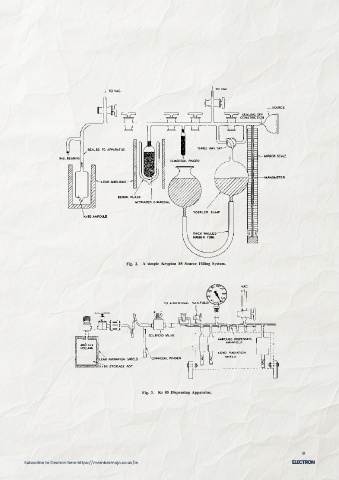
 appear relatively low, that due to tritium is based upon   in  a  mixture of gases,  which  is  mainly  oxygen  and   Fig. 2.  A  simple  Krypton  85 Source  Filling System.
 tritium  in  the  form  of  tritiated water  which, when   nitrogen.  The purification entails liquefaction  and dis-
 breathed  into  the lungs,  is  completely metabolised.  It   tillation  under  reflux  to  remove  the less condensible
 is, however, released  from  the  body  with  a  biological   gases,  followed by  a charcoal chromatographic method
 half  life  of  a  few  days,  which  can  also  be reduced by   to separate krypton from inert xenon.  The final product
 increasing the  turn-over  of water  through  the  body.   is  pure  krypton  containing  a  trace  of xenon.
 Only  a  fraction  of one  per  cent.  of tritium  as the   Handling  of  millicurie  quantities  of  Kr 85  can  be
 hydrogen  molecule  is  metabolised  by being  converted   carried  out  in  conventional  high  vacuum  glass  appara-
 to water on passage through the lungs.  Since detecting   tus, with  localised  shielding where the concentration of
 equipment  is  unable  to  differentiate  between  HT and   the gas  is  expected  to  be greatest.  In  order  to  reduce
 HTO,  and  the  presence  of a  flame  or hot metal  in  the   the  beta  particle  penetration it  is  advisable  to  ensure
 vicinity of a tritium leak will result in some conversion   that the  glass  tubing less than  1  mm  wall  thickness  is
 of HT to HTO, most operators work at the lower m.p.l.   not used.  Fig. 2 illustrates a simple apparatus for filling
 level for safety reasons.   sources from a stock of Kr 85 which may be as much as
 The other radioactive gases  are completely inert, and   1  curie. The charcoal storage trap is filled with sufficient
 in  many respects,  less  hazardous  than  tritium.  None   activated  charcoal  to  ensure  that the partial  pressure of
 gas above the charcoal at room temperature is less than
 arc  metabolised  in  the  body,  and the  m.p.l.  quoted  is   one atmosphere.  On cooling with liquid air,  the kryp-
 based  upon  a  man  standing  in  an  infinite cloud  of  the   ton is completely adsorbed.  Consequently, after filling
 gas,  i.e. at the centre of a sphere of radius 8 feet which   a  source,  the  unused material  can  all  be  re-transferred
 is the  maximum range  of a  Kr 85  beta particle.  Even   to  the storage pot.  In  the  event  of only dry  ice being
 the  clothes  on  one's body  can  afford  some  protection   available as a  refrigerant,  the partial pressure above the
 from the beta rays of both Kr and Xe.   charcoal when  cooled  to  -80°C may  be  a  few  mm
 In  addition,  the  gases  are invariably  sealed  in  con-   mercury.  Any gas  remaining in  the dead  space of the
 tainers  at sub-atmospheric  pressure,  which  means that,   system  can  then  be  salvaged  by  isolating  the stock
 in  the  event  of a  leak occurring,  air will first enter the   vessel  and  adsorbing  the remaining  krypton  onto  the
 container  and  leakage  out will  be  so  slow  as  to  result   charcoal finger also cooled to -80°C.   Fig. 3.  Kr  85 Dispensing  Apparatus.
 24                                                          25


 30                                                                                                        31
 Subscribe to Electron here https://membermojo.co.uk/ie  Subscribe to Electron here https://membermojo.co.uk/ie

