


Page 25 - Summer 2025
P. 25
Industry News


          alignment of the solar eclipse. The Coronagraph       Bath Space Weather Sensors to launch in 2027
          contained the imaging equipment whilst the
                                                                Space weather sensors developed at the University
          Occulter, positioned 150 metres away, used a 140cm
                                                                of Bath are due to be launched in 2027 as part of the
          disc to block the Sun’s intense light. A combination
                                                                TOPCAT II project, designed to take measurements
          of camera technology, laser rangefinding, cold
                                                                of atmospheric conditions in space to inform
          gas propulsion and advanced navigation software
                                                                improvements to technologies such as GPS.
          enabled the precise alignment required to cast a
          millimetre-accurate shadow onto the optical system
          of Coronagraph.
          The observation occurred at a distance of around
          60,000 kilometres from Earth with each elliptical orbit
          requiring the two satellites to independently detect,
          align and maintain their respective positions for up
          to six hours with a stability of under a millimetre, all
 FOCUS ON SPACE  without human intervention.


                                                                Created at the University of Bath Department of
                                                                Electronic and Electrical Engineering, the second
                                                                TOPCAT (Topside ionosphere Computer Assisted
                                                                Tomography) forms part of the £5.15 million Orpheus
                                                                mission, which follows from the Prometheus-2 and
 Robots set to build Infrastructure in Space  Space Solar selected the UKAEA Centre for Remote   CIRCE missions which resulted in the loss of the
 Applications in Challenging Environments because               original TOPCAT.
 The United Kingdom Atomic Energy Authority
 fusion and space robotics have a number of things
 (UKAEA) and space-tech company Space Solar                     The TOPCAT II payload measures 9x7cm and carries
 in common, in particular the fact that neither require
 have demonstrated that robots could build                      an advanced multi-frequency GPS receiver that
 oxygenated environments and both can function in
 infrastructure in space without human intervention.            aims to estimate the total electron content of the
 varying degrees of radiation. Together they have the
                                                                ionosphere, helping to gain a better understanding of
 The AlbaTRUSS project, conducted at the UKAEA   potential to provide constant, low-carbon baseload
                                                                the driving processes of geophysical phenomena in
 advanced test facility at Culham in Oxfordshire,   energy around the world.
                                                                the ionosphere-thermosphere system.
 showed that remotely operated dual-arm robotic
 Dr. Sam Adlen, Co-COE of Space Solar, comments:
 manipulators were able to guide robots to assemble             Professor Cathryn Mitchell, who helped design
 gigawatt-scale solar power satellites, paving the way   “The AlbaTRUSS project is a milestone not just for   By providing stable and extended eclipse conditions,   TOPCAT, states:
 for robots to assemble infrastructure such as data   our satellite architecture, but for the future of large-
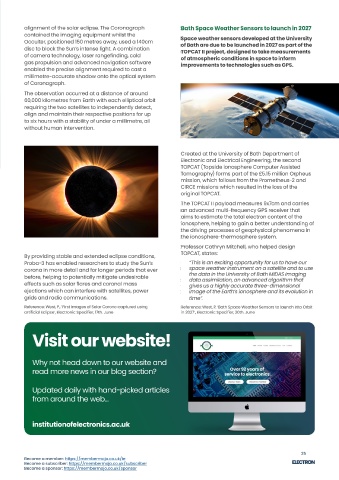
          Proba-3 has enabled researchers to study the Sun’s       “This is an exciting opportunity for us to have our
 centres in orbit.  scale structures in space, from data centres to   space weather instrument on a satellite and to use
          corona in more detail and for longer periods that ever
 energy infrastructure.                                            the data in the University of Bath MIDAS imaging
 Space Solar aims to harness abundant solar energy   before, helping to potentially mitigate undesirable
                                                                   data assimilation, an advanced algorithm that
 in space and beam it back to Earth using satellites   Up in space, the Sun shines 24/7. Once constructed,   effects such as solar flares and coronal mass   gives us a highly accurate three-dimensional
 consisting of hundreds of thousands of modular   these satellites capture solar power and beam   ejections which can interfere with satellites, power   image of the Earth’s ionosphere and its evolution in
 units assembled into structures 20 metres wide and   it back down to Earth in the form of microwaves,   grids and radio communications.  time”.
 several kilometres in length. AlbaTRUSS as a proof-  which can be received by antennas on the ground
          Reference: West, P., ‘First Images of Solar Corona captured using   Reference: West, P. ‘Bath Space Weather Sensors to launch into Orbit
 of-concept project has shown that robots could be   and converted into electricity for the grid.
          artificial Eclipse’, Electronic Specifier, 17th. June  in 2027’, Electronic Specifier, 20th. June
 used to assemble a scaled structural truss bay or
 The achievement opens up new horizons for the
 ‘longeron’ tubing, which forms a core element of the
 space sector, an adjacent economic sphere that
 satellite’s framework.
 can ensure a bright future here on Earth”.
 Reference: Gittins, C., ‘Robots could build Infrastructure in Space’,   Visit our website!
 Electronic Specifier, 2nd. June
 Artificial Eclipse captures first Images    Why not head down to our website and
 of Solar Corona  read more news in our blog section?
 The first successful imaging of the Sun’s corona
 from space has been achieved using a pair of
            Updated daily with hand-picked articles
 synchronised satellites to create an artificial solar
 eclipse.   from around the web...
 The European Space Agency’s Proba-3 mission,
 which involved 29 companies from 17 countries,
 used the two satellites Coronagraph and Occulter in   institutionofelectronics.ac.uk
 high-precision formation flying to recreate the optical


 24                                                                                                        25
 Become a member: https://membermojo.co.uk/ie  Become a member: https://membermojo.co.uk/ie
 Become a subscriber: https://membermojo.co.uk/subscriber  Become a subscriber: https://membermojo.co.uk/subscriber
 Become a sponsor: https://membermojo.co.uk/sponsor  Become a sponsor: https://membermojo.co.uk/sponsor

