


Page 11 - Summer 2025
P. 11
Multiphoton 3D Lithography produces minute   First Testing Facility for testing Materials   replicated anywhere in the world at the moment,
 Replica of Sorbonne University Chapel  3D-printed in Space        will help regulatory authorities to make safety
                                                                   standards for in-space manufacturing informed by
 An advanced laser nanofabrication technique   The world’s first dedicated facility for testing the
                                                                   real-world testing”.
 known as multiphoton 3D lithography has been   structural integrity of materials that are 3D-printed
 used to produce a minute replica of Sorbonne   in space has been constructed at the University of   Reference: ‘First-of-its-kind Test Facility could help Space Industry
 University Chapel.  Glasgow’s James Watt School of Engineering.  dodge a Bullet’, Instrumentation Monthly, May 2025, p.5

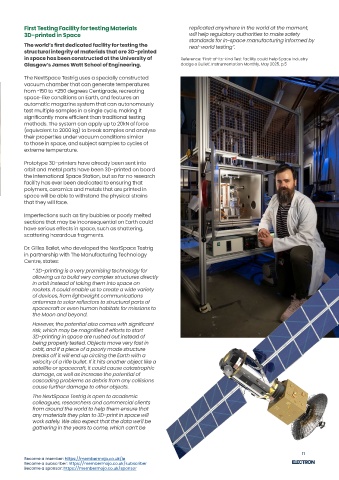
          The NextSpace Testrig uses a specially constructed
          vacuum chamber that can generate temperatures
          from -150 to +250 degrees Centigrade, recreating
          space-like conditions on Earth, and features an
          automatic magazine system that can autonomously
          test multiple samples in a single cycle, making it
 Earthquake Simulation Stress Tests 3D-printed
          significantly more efficient than traditional testing
 Concrete House  methods. The system can apply up to 20kN of force
 Scientists at the University of Bristol have deployed   (equivalent to 2000 kg) to break samples and analyse
 the UK’s largest shaking table to simulate the   their properties under vacuum conditions similar
 effects of a medium-magnitude earthquake on a   to those in space, and subject samples to cycles of
 3D-printed concrete house.  extreme temperature.
 Traditional concrete structures have well-established   Prototype 3D-printers have already been sent into
 seismic resilience, but 3D-printed concrete structures
          orbit and metal parts have been 3D-printed on board
 introduce new variables such as layered deposition,   the International Space Station, but so far no research
 unique material properties and unique geometries.
          facility has ever been dedicated to ensuring that
 Testing used a high-end shaking table capable   polymers, ceramics and metals that are printed in
 of holding up to 50 tonnes and of simulating the   space will be able to withstand the physical strains
 ground motions representative of a real earthquake.   that they will face.
 The house was created using a robotic additive
 The replica, the length of which is approximately 120
 manufacturing process with controlled material   micrometres, and which is around 275,000 times   Imperfections such as tiny bubbles or poorly melted
 deposition and geometry, and incorporated   sections that may be inconsequential on Earth could
 smaller than the real chapel, was produced by
 accelerometers, displacement sensors and various   Dr. Gordon Zyla, a senior researcher at the Vilnius   have serious effects in space, such as shattering,
 gauges designed to capture a comprehensive set of   scattering hazardous fragments.
 University Faculty of Physics. With all of the intricate
 dynamic response data.  architectural details of the original preserved, it was
          Dr. Gilles Bailet, who developed the NextSpace Testrig
 In the test the unit was subjected to increasing   gifted to the President of Sorbonne University, Professor   in partnership with The Manufacturing Technology
 intensity ground motion with each test sequence   Nathalie Drach-Temam during a high-level delegation   Centre, states:
 allowing for real-time assessment of cracking,   visit.
 displacement and potential failure points. The   “ 3D-printing is a very promising technology for
 Dr. Zyla explains how this advanced form of
 resultant data then enabled evaluation of the   3D-printing operates:  allowing us to build very complex structures directly
 structured resilience of the 3D-printed unit, allowing   in orbit instead of taking them into space on
 for comparison of its performance relative to   “Unlike conventional 3D-printing, this approach   rockets. It could enable us to create a wide variety
 traditional construction methods and validation of   can solidify a light-sensitive material at virtually   of devices, from lightweight communications
 any point in space, enabling the fabrication of   antennas to solar reflectors to structural parts of
 computational models that are used as predictors of
 truly three-dimensional structures. Interestingly,   spacecraft or even human habitats for missions to
 seismic behaviour.
 by using a sharply-focused ultrashort-pulse laser   the Moon and beyond.
 Project Lead Dr. Raffaele De Risi states:  beam, it is possible to initiate a polymerisation
            However, the potential also comes with significant
 reaction with such precision that it creates spatial
 “Insights from this study will help identify design   risk, which may be magnified if efforts to start
 elements, or voxels, just a few hundred nanometres
 parameters that optimise seismic performance,   3D-printing in space are rushed out instead of
 in size. For comparison, a human hair is about 80
 such as layer bonding strategies and   being properly tested. Objects move very fast in
 micrometres thick, roughly 500 times wider than
 reinforcement integration.  orbit, and if a piece of a poorly made structure
 the structures created by this method.
            breaks off it will end up circling the Earth with a
 Ultimately we hope to validate whether 3D-printed
 Simple spherical microelements - six times smaller   velocity of a rifle bullet. If it hits another object like a
 concrete can meet current safety standards for
 than the chapel - can improve the resolution   satellite or spacecraft, it could cause catastrophic
 seismic applications and provide a foundation for
 of optical microscopes beyond what standard   damage, as well as increase the potential of
 developing building codes that include additive
 lenses can achieve. Other tiny structures, carefully   cascading problems as debris from any collisions
 manufacturing technologies.
 arranged in patterns, can shape and control   cause further damage to other objects.
 By testing the seismic resilience of 3D-printed   light in new ways to enable novel interactions
            The NextSpace Testrig is open to academic
 concrete for the first time, we’re not just exploring   with matter. This may open up possibilities for
            colleagues, researchers and commercial clients
 the future of construction, we’re helping shape   future applications in bio-imaging, quantum
            from around the world to help them ensure that
 a safer, smarter and more adaptive built   technologies, telecommunications and laser
            any materials they plan to 3D-print in space will
 environment”.  technologies”.  work safely. We also expect that the data we’ll be
            gathering in the years to come, which can’t be
 Reference: West, P., Electronic Specifier, 18th. June  Reference: Miles, S., ‘Vilnius University’s Gift to Sorbonne University
 President’, Electronic Specifier, 1st. July
 10                                                                                                        11
 Become a member: https://membermojo.co.uk/ie  Become a member: https://membermojo.co.uk/ie
 Become a subscriber: https://membermojo.co.uk/subscriber  Become a subscriber: https://membermojo.co.uk/subscriber
 Become a sponsor: https://membermojo.co.uk/sponsor  Become a sponsor: https://membermojo.co.uk/sponsor

